A bifocal has two distinct zones of correction — usually distance up top and near vision in a segment at the bottom, separated by a visible line. A progressive does the same job of covering multiple distances, but blends them into one lens with no line at all. The difference is as much about how the lens looks as how it works.
What is a bifocal lens, exactly?
A bifocal lens has two separate optical zones ground into one piece of glass or plastic, most commonly distance correction across the main lens and a near-vision segment set into the lower portion. The join between them is visible as a line or a crescent shape.
That segment shape and size is decided with an optician, along with everything else about how the two zones are set up for a particular pair of eyes. This article isn’t the place to weigh in on what any of that should be — that’s a fitting decision, not a styling one.
What’s relevant here is the visible line itself. Some people don’t mind it; others find it reads as dated, and it’s one of the reasons progressives became the default alternative once the technology matured.
What is a progressive lens, exactly?
A progressive lens moves gradually from distance correction at the top through an intermediate zone in the middle to near correction at the bottom, with no visible line anywhere on the lens. From the outside, a progressive looks exactly like a single-vision lens.
The trade-off for that invisibility is a narrower usable width at each point in the transition, and a short adjustment period while the eyes and head learn to find the right zone for the right task. There’s a dedicated explanation of that progressive lens adaptation period worth reading if this is new territory, because it covers what the settling-in phase actually feels like day to day.
Progressives sit at the more complex end of what a lens can do. At the simpler end is the single-vision lens, which corrects one distance only — useful context for understanding why bifocals and progressives exist at all.
Why do progressives look different on the face?
They don’t, and that’s the point. A progressive lens has no visible dividing line, so from across a room or in a photograph it reads identically to a single-vision lens. A bifocal’s line is visible at conversational distance and shows up under certain lighting.
Some people prefer the line precisely because it’s honest about what the lens does. Others want the correction to disappear into the frame entirely. Neither preference is more sophisticated than the other — it’s a genuinely personal call, and one more reason this decision belongs with an optician who can talk through both the visible and optical trade-offs together.
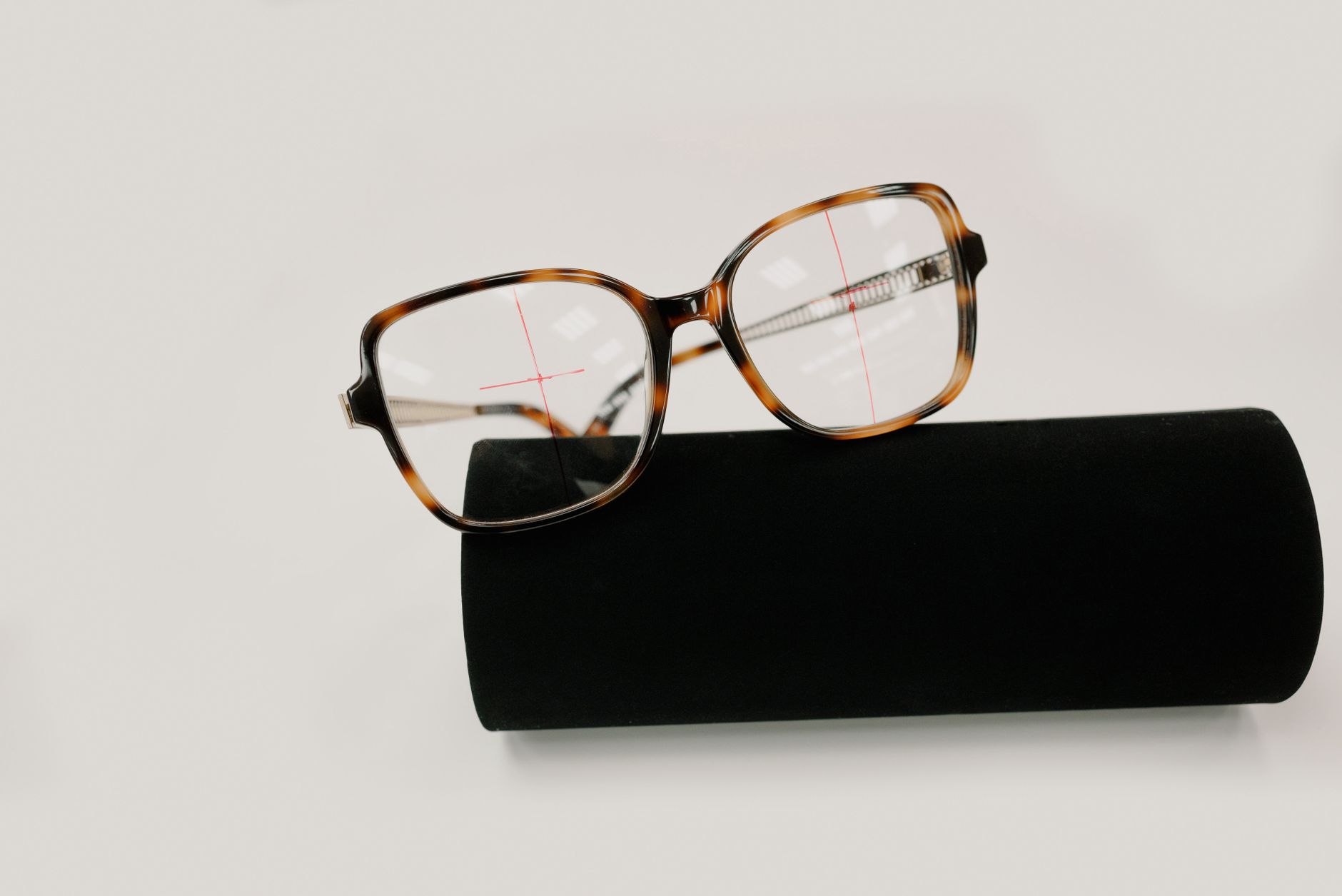
Does the frame shape matter more with one than the other?
Progressives are more particular about frame depth than bifocals, because the whole point of a progressive is the vertical corridor it needs to move smoothly from distance to near. A very shallow frame gives that corridor less room to work with.
This is where frame choice and lens choice genuinely intersect. A deep, rounder shape like a panto frame tends to give a progressive more usable depth than a slim, low-profile rectangle. It’s worth having this conversation with an optician before falling for a frame shape that turns out to be too shallow for the lens design being fitted into it. Browsing the wider frames and styles archive is a reasonable place to get a feel for proportion before that conversation happens.
Bifocals are more forgiving of frame depth because the near segment only needs enough vertical space to sit in the lower portion of the lens, not to blend gradually through the whole thing.
Which one is easier to adapt to?
Bifocals tend to have a shorter adjustment period because the two zones are distinct — the eye either looks through the top or the bottom, with an obvious jump between them. Progressives ask more of the eye and head initially, because finding the right point in a gradual transition is a learned habit rather than a jump.
Neither adaptation period is something to self-diagnose from an article. If the transition feels unusually difficult, or vision seems worse rather than just unfamiliar, that’s a conversation for the optician who did the fitting — not something to work through alone.
It bears repeating separately from adaptation: any sudden change in vision, eye pain, flashes, new floaters, halos around lights, or vision loss in one eye is a same-day matter for an eye professional, regardless of what lens is being worn at the time.
Does one make lenses thicker than the other?
Lens thickness on either type is driven mainly by the same factors as any prescription lens — the correction needed and the lens index chosen to manage that thickness — rather than by the bifocal or progressive design itself. Progressive lenses do involve more complex surface calculations, which is part of why they’re generally priced above an equivalent single-vision or bifocal lens, but that’s a manufacturing consideration, not a thickness rule.
For anyone with a stronger prescription concerned about lens edge thickness in either design, the honest starting point is a conversation about index with an optician, alongside understanding Abbe value and what it trades off against a higher index. Neither of those decisions belongs in a styling article, but knowing the vocabulary makes that conversation more useful.
Does one look more “youthful” than the other?
This is styling opinion, not science, but it’s worth saying plainly: a visible bifocal line has become culturally associated with an older wearer, fairly or not, simply because progressives became the more common choice once they were widely available. That association says nothing about how well either lens performs.
Plenty of people wear a lined bifocal and it reads as nothing more than a pair of glasses — the line is far less noticeable than most people assume once a frame and coating are chosen well. A good anti-reflective coating reduces the kind of glare that can make any lens line, edge, or reflection more visible under artificial light.
Is one simply “better” than the other?
Better is the wrong frame for this. A bifocal is a more direct, mechanically simpler lens with a shorter learning curve and a visible line. A progressive is a more visually seamless lens with a more gradual learning curve and more particular frame requirements. Which one suits a given pair of eyes, a given prescription, and a given lifestyle is a clinical decision, and it sits entirely with an optician.
What does belong in this kind of publication is the aesthetic and practical fallout of that decision — how the lens sits in a frame, what shapes give it room to work, and how it reads to other people day to day.
What should actually get compared before deciding on a frame?
Once the lens type is settled with an optician, the frame conversation becomes about proportion and construction rather than lens design in isolation.
- Frame depth, particularly for a progressive, which needs vertical room to transition smoothly
- Bridge fit and how consistently the frame sits at the same height on the face, since both lens types rely on consistent positioning
- Lens coatings such as anti-reflective treatment, which affect how visible any transition or edge appears under light
- Overall frame proportion against the face, the same consideration covered across the frames and styles archive regardless of what’s inside the lens
None of that changes what a bifocal or progressive does optically. It changes how comfortably and how invisibly either one sits on a particular face — which, for most people wearing glasses every day, is most of what actually matters once the prescription itself is settled.
The Designer Glasses publishes general information and style opinion, not professional advice. We are writers and enthusiasts, not opticians, optometrists or dispensing opticians. Nothing here interprets a prescription, recommends a lens power, or tells you whether you need correction — only an eye examination can do that. If your vision changes suddenly, or you have eye pain, flashes, new floaters or halos around lights, treat it as urgent and contact an eye care professional the same day. Sunglasses should carry a stated UV rating: a dark lens without UV filtering is worse than none at all.