A progressive lens is a single lens that blends several focusing powers into one smooth surface, letting the wearer see clearly at distance, at arm’s length and up close without switching glasses or looking through a visible line. Most people need a few days to two weeks to adapt, though how the lens fits your face matters as much as the lens itself.
What actually makes a lens “progressive”?
A progressive lens changes its focusing power gradually from top to bottom, rather than jumping between two fixed powers like an old-fashioned bifocal. The upper part of the lens is set for distance, the middle transitions through intermediate distances such as a computer screen, and the lower section is for close work like reading.
The clever part — and the tricky part — is that this transition has to happen somewhere, and it happens across the surface of the lens rather than at a hard edge. That’s what removes the visible line. It’s also why the sides of the lens, away from that central corridor of clear vision, carry some distortion. That trade-off is inherent to the design, not a flaw in a particular pair.
This sits in the same family of decisions as choosing between a single-vision lens and something that does more than one job. A single-vision lens corrects one distance only, which is simpler optically and has none of the adaptation curve described below.
Why does the adaptation period exist at all?
The brain has to learn a new relationship between where the eyes point and what part of the lens they’re looking through. Distance sits up top, near work sits down low, and everything else is a gradient in between — that mapping isn’t automatic on day one.
Historically this has been explained as the eyes and brain “learning” the lens, and that’s broadly right, but it undersells how mechanical it is. Reading through a progressive lens means dropping the chin slightly and looking down through the lower zone, rather than dropping only the eyes as many people are used to doing with single-vision reading glasses. Walking downstairs while looking through the distance zone, rather than the near zone at the bottom, is the classic early stumble.
None of this is a symptom in the medical sense — it’s a coordination habit forming. But if vision changes suddenly, or something like eye pain, flashes, new floaters, halos around lights, or loss of vision in one eye turns up at any point, that’s a same-day matter for a professional, adaptation period or not.
What does the first week actually feel like?
Peripheral areas of the lens can look soft or slightly warped, especially near the bottom edges, and this is most noticeable when the eyes move rather than the whole head. Some wearers also notice a mild sense of movement or “swim” when walking, particularly on stairs or uneven ground.
The fix, in the early days, is mostly behavioural rather than optical:
- Move the head to look at something rather than just flicking the eyes to the edge of the lens.
- Give the eyes a beat to settle when shifting from a screen to a phone to a shop shelf, rather than expecting instant clarity.
- Wear the glasses consistently through the adaptation period rather than swapping in and out, since inconsistent use tends to prolong it.
For most people this settles within a few days to two weeks. If clear, comfortable vision still hasn’t arrived well past that point, that’s worth raising with the optician who fitted the glasses — not something to just live with.
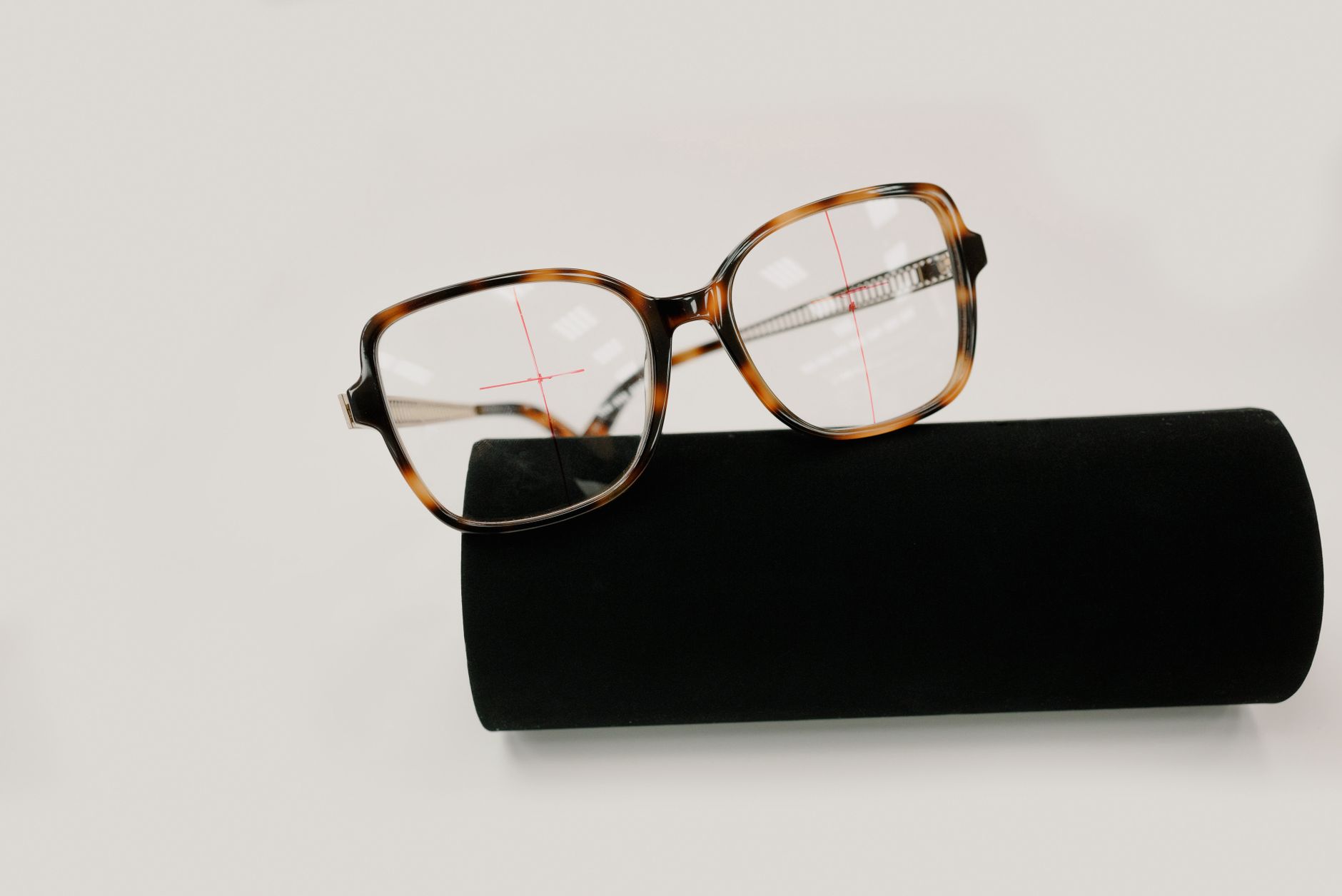
Does the frame you choose affect how easy adaptation is?
Yes, more than most people expect. Progressive lenses need vertical room on the lens to fit the full distance-intermediate-near gradient, so a very shallow frame — a slim rectangle or a narrow rimless shape — compresses that gradient into less space and can make the usable zones feel cramped.
This is a genuine styling consideration, not just an optical one. A deeper panto shape or a classic P3 frame shape generally gives a progressive lens more room to work with than a shallow rectangular frame does, and that can make the difference between an easy adaptation and a frustrating one. Anyone drawn to a very slim silhouette is best raising it with their optician before ordering, so the lens design can be matched to the frame rather than fighting it.
Frame fit also matters in the more basic sense of staying put. A progressive lens depends on the eye looking through a specific, fairly narrow zone for each task, so if the frame slides down the nose or sits crooked, the wearer ends up looking through the wrong part of the lens without realising why things look off. This is one of the few cases where a professional fitting check is genuinely part of the optical performance, not just comfort.
Is a progressive lens the same as a bifocal?
No. Both correct more than one distance in a single lens, but a bifocal has a visible line separating two fixed powers, while a progressive lens blends the powers gradually with no line and typically adds a true intermediate zone that bifocals lack.
That intermediate zone is a big part of why progressives suit modern life — a computer monitor sits at a distance that a traditional bifocal, designed around distance and close reading only, doesn’t really address. Whether either design is the right call for a given prescription is a conversation for an optician, not something styling preference or general reading can settle.
Do progressive lenses limit lens colour or coatings?
Not in any way that changes the core advice for other lens types. Anti-reflective coating, for instance, still does the same job on a progressive lens as on any other — cutting the reflections off the front and back surfaces that make eyes harder to see and can make the lens itself look busier. The mechanics of that are covered in more depth in what an anti-reflective coating actually does.
Progressive designs are also available as prescription sunglasses, and the same rule applies there as anywhere else: tint depth says nothing about UV protection. A dark lens without a stated UV filter is worse than no sunglasses at all, because the tint opens the pupil while offering no actual barrier to UV reaching the eye. Look for a UV400 label or a stated 100% UVA/UVB filter, not how dark the lens looks or what it cost. That distinction is unpacked properly in what a UV400 rating actually means, and the difference between fixed and light-reactive tints is covered in what photochromic lenses are and where they struggle.
What should be compared when choosing a progressive lens design?
Progressive lens designs vary in how wide the usable zones are and how much peripheral distortion they carry, and this is genuinely worth discussing with an optician rather than assuming all progressives are equivalent. What’s useful to understand going in:
- How much of the lens surface is dedicated to intermediate vision, since that affects screen comfort specifically.
- How the design responds to frame shape and size — a lens matched to a shallow frame will differ from one matched to a deeper shape.
- Lens thickness and how it’s managed, which is where lens index and Abbe value become relevant for stronger prescriptions — both explained in plain terms elsewhere on this site, without recommending a specific number for anyone’s own prescription.
None of that is a matter of picking the “best” option off a shelf. It’s a fitting conversation, and the right answer depends on the prescription, the frame chosen and how someone actually uses their eyes day to day — screens, driving, reading — which only an optician looking at all three together can properly judge.
Does frame style still matter with a progressive lens?
Completely — a progressive lens doesn’t change the fact that glasses are worn on the face all day and read as part of an outfit. The optical requirement (vertical depth, good fit) narrows the shortlist slightly, but within that there’s still plenty of room for taste.
A deeper panto, a browline, or a well-proportioned square frame all tend to have enough vertical room to suit a progressive lens comfortably, and the full range of shape considerations — proportion, bridge style, colour — is covered across the frames and styles archive. For anyone also considering how a progressive prescription works in sunglasses, the sunglasses archive and the broader mechanics of tints, coatings and lens behaviour sit in the lenses and coatings archive.
The Designer Glasses publishes general information and style opinion, not professional advice. We are writers and enthusiasts, not opticians, optometrists or dispensing opticians. Nothing here interprets a prescription, recommends a lens power, or tells you whether you need correction — only an eye examination can do that. If your vision changes suddenly, or you have eye pain, flashes, new floaters or halos around lights, treat it as urgent and contact an eye care professional the same day. Sunglasses should carry a stated UV rating: a dark lens without UV filtering is worse than none at all.