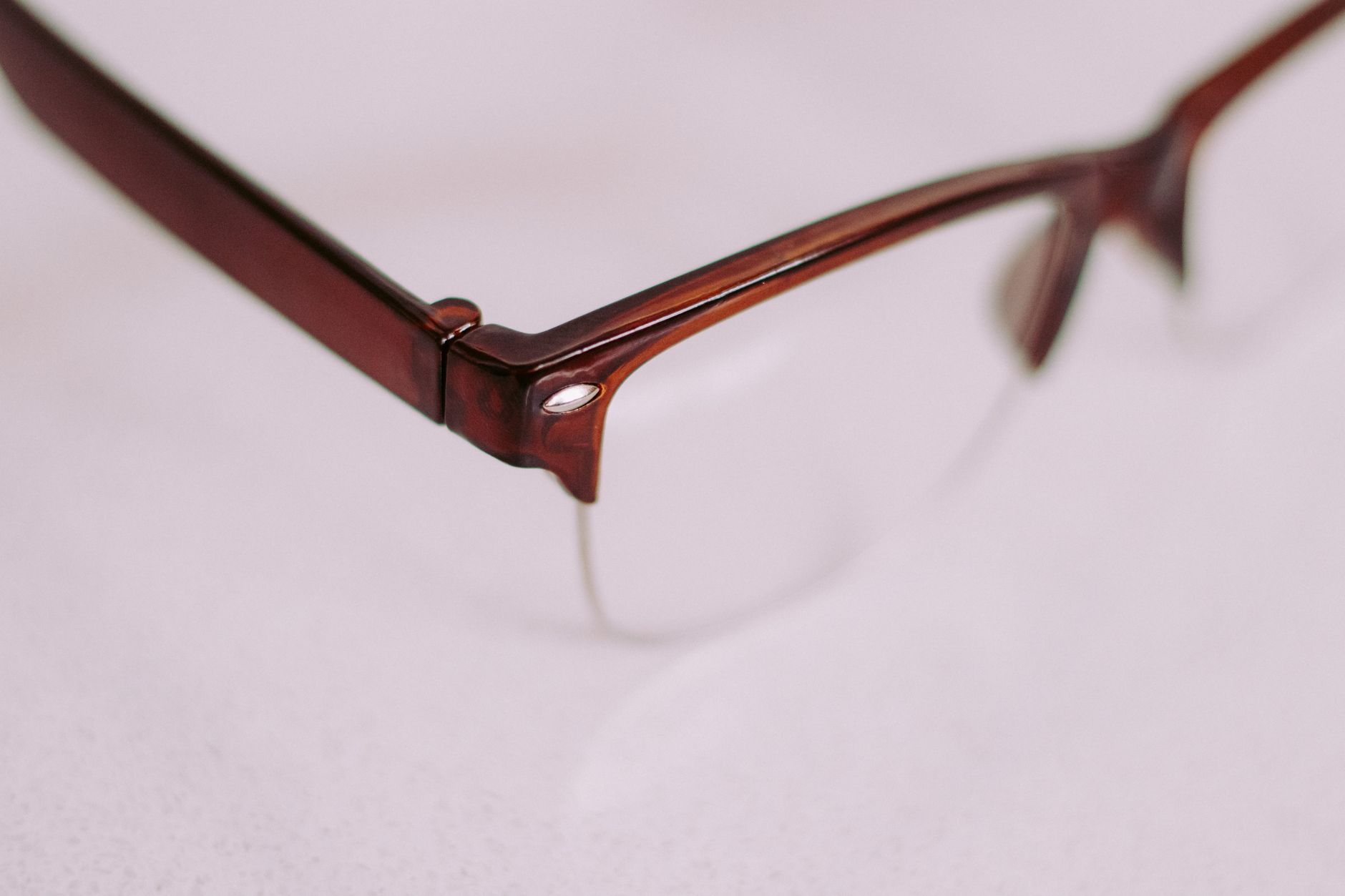
A screwless hinge joins the temple to the frame front without a visible screw holding it together. Instead, the two parts are held by a pin, a spring-loaded barrel, or a friction-fit mechanism built into the metal or acetate itself. The name refers to what you can’t see, not to an absence of engineering.
It’s a small detail, but it’s one of the first things a good eyewear person checks when they pick up a frame. The hinge is where a pair of glasses works hardest — opened and closed hundreds of times a month, torqued sideways when pulled off one-handed, exposed to sweat and hair product. How that joint is built says a lot about how the rest of the frame was made.
How does a screwless hinge actually work?
Most screwless hinges rely on a spring-loaded pin or plunger set into a barrel, rather than a threaded screw passing through both leaves of the hinge. The pin is held under tension and locks into a matching groove or notch, so the temple pivots on the pin instead of on a screw shaft.
There are a few common variants. Some use a single hardened pin pressed through both halves of the hinge and secured by tension alone, similar in spirit to a rivet but designed to be serviceable. Others use a barrel-and-plunger system, often marketed under names specific to a manufacturer, where a small spring-loaded rod snaps into place and can be pushed out again with the right tool. A few high-end metal frames dispense with a separate pin entirely and use a flexed, interlocking piece of the hinge itself, so the two halves click together and stay together through spring tension in the metal.
What they share is the absence of a screw thread that can work loose, back out, or strip. That’s the whole point of the design.
Why would a maker avoid using a screw?
Screws are cheap and easy to service, but they’re also the single most common point of failure on a pair of glasses — they loosen with vibration and repeated opening, and the threads can strip if over-tightened during a repair. A screwless hinge removes that specific weak point.
Anyone who wears glasses long enough has felt a temple go slightly loose and wobbly, usually followed by a trip to have the screw tightened, and eventually a stripped thread that won’t hold at all. It’s a nuisance rather than a disaster, and it’s fixable — but it happens, and it happens more to frames that get handled roughly or adjusted often. A screwless hinge is an attempt to design that failure mode out entirely, by replacing a threaded fastener with a pin or spring that either holds under tension or doesn’t move at all.
This matters more on frames that get a lot of daily wear — pushed up onto the head, folded one-handed, tossed into a bag rather than a case. It matters less on a pair kept mostly for reading at a desk, which is worth remembering before paying a premium for a mechanism the frame may never really stress-test.
Is a screwless hinge the same as a spring hinge?
No. A spring hinge is about how far the temple can flex outward past its natural resting position, giving a bit of give when the glasses are put on or taken off. A screwless hinge is about how the temple is physically attached to the front — the two ideas can overlap, or exist independently.
It’s entirely possible to have a spring hinge secured by a conventional screw, and equally possible to have a rigid, non-flexing screwless hinge that offers no extra give at all. The two features solve different problems. One is about comfort and forgiveness in fit; the other is about the mechanical reliability of the joint itself. For a closer look at how spring mechanisms behave and where they eventually give out, it’s worth reading about how a spring hinge works and how it fails, which covers a genuinely different piece of the hinge conversation.
How does it compare to a rivet hinge?
A rivet hinge is riveted permanently at the factory and essentially can’t be taken apart for standard servicing — it’s chosen for looks and tradition rather than repairability. A screwless hinge, by contrast, is usually designed so an optician can still open and re-tension it with the right pin tool.
Rivet hinges show up on frames aiming for a vintage or handmade look, where the visible rivet is treated as a design feature rather than something to hide. Screwless hinges tend to aim for the opposite effect — a cleaner, more minimal profile where nothing distracts from the line of the temple. Both are legitimate choices with different priorities, and it’s worth reading about why some makers still use a rivet hinge to see how the two philosophies sit next to each other.
What does it mean for repairs and adjustments?
A screwless hinge can usually still be adjusted for tension and angle, but it typically needs the right pin-removal tool rather than a standard jeweller’s screwdriver. A general repair shop without that specific tool may not be able to service it, which is worth knowing before it becomes urgent.
This is the trade-off worth being honest about. The mechanism solves the loosening-screw problem neatly, but it can shift the servicing burden onto specialist opticians or the original retailer, particularly for mechanisms proprietary to one manufacturer. Before buying a frame with an unusual hinge, it’s reasonable to ask where it can be serviced later, not just whether it looks well made in the shop. For a broader sense of what can and can’t be fixed on a pair of glasses generally, see what can be adjusted and what can’t be fixed.
Does the hinge type affect how the frame looks?
Yes, though subtly. A screwless hinge tends to read as cleaner and more architectural, since there’s no visible screw head interrupting the line where temple meets front. On a minimal metal frame or a fine acetate temple, that absence of hardware can genuinely change the character of the piece.
This matters most on frames where the hinge sits in plain view rather than tucked under a thick temple tip. Titanium and steel frames with slim, exposed hinges show off the mechanism more than a chunky acetate frame does, so the choice of hinge becomes part of the design language rather than a hidden detail. It’s the kind of thing worth noticing when comparing what titanium buys a frame against a similar shape in stainless steel — the metal changes not just the weight but the hardware that’s possible.
Should a screwless hinge influence which frame to buy?
It shouldn’t be the deciding factor on its own, but it’s a reasonable thing to check alongside fit, weight and material when comparing two similar frames. A well-made screwless hinge is a mark of attention to construction; a poorly made one offers no real advantage over a well-executed screw hinge.
What matters more day to day is whether the hinge holds tension evenly on both sides, whether the temple sits flush against the head without gapping, and whether the whole frame feels balanced when worn for hours rather than tried on for a minute in a mirror. Hinge type is one input into that, not the whole answer. It sits alongside broader questions of build — the kind covered in materials and craft more generally — and alongside comfort factors like temple length and how the frame distributes weight across the nose and ears, discussed in what makes a frame comfortable over eight hours.
None of this touches on vision, correction or anything a prescription determines — that’s a conversation for an optician, not a hinge mechanism. But for the mechanics of how a frame is put together and how long it’s likely to hold up, the hinge is one of the more honest details on the whole piece. It’s worth a look before the fit and the shape, both explored further in frames and styles, take over the decision entirely.
The Designer Glasses publishes general information and style opinion, not professional advice. We are writers and enthusiasts, not opticians, optometrists or dispensing opticians. Nothing here interprets a prescription, recommends a lens power, or tells you whether you need correction — only an eye examination can do that. If your vision changes suddenly, or you have eye pain, flashes, new floaters or halos around lights, treat it as urgent and contact an eye care professional the same day. Sunglasses should carry a stated UV rating: a dark lens without UV filtering is worse than none at all.