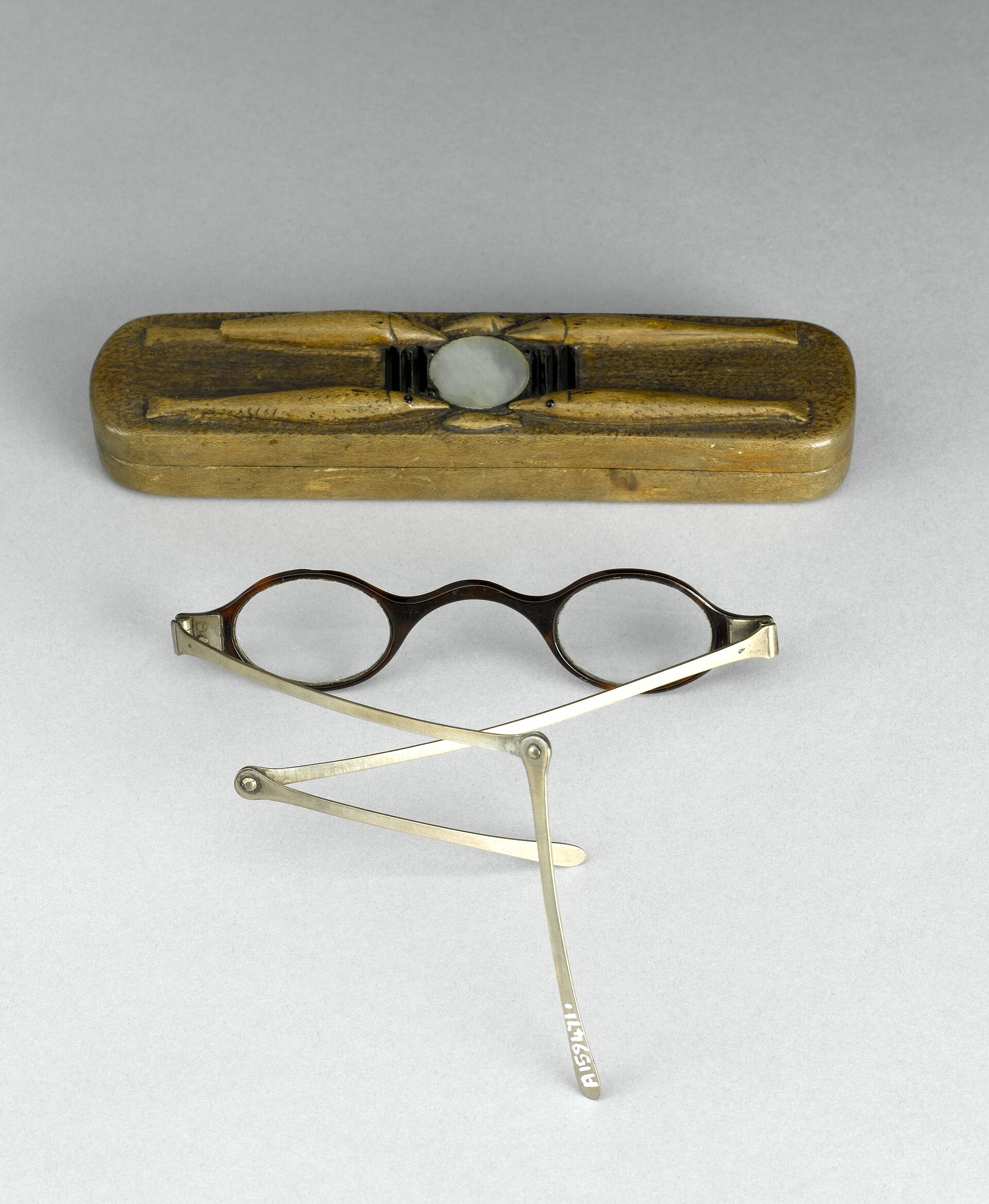
A folding frame is a pair of glasses with an extra hinge built into the bridge or the front, letting the frame collapse into a smaller shape than normal temple hinges allow. The cost is mechanical: a second moving joint on the part of the frame that holds your prescription in alignment, and a second place for wear to show up.
What exactly is a folding frame?
Every pair of glasses has hinges — the two joints where the temples meet the front, letting them swing open and shut. A folding frame adds a third hinge, usually at the center of the bridge, so the entire front can fold in half. Some designs fold the temples back on themselves as well, so the whole pair compresses into a flat case roughly the size of a phone. The appeal is obvious: it is a frame built to disappear into a jacket pocket or a bag without the bulk of a standard case.
This is a mechanical category, not a look. Folding frames turn up across frame shapes and styles, from rectangular metal frames to round acetate ones, because the folding mechanism sits in the bridge rather than dictating the shape of the lens.
Where does the extra hinge actually go?
Most folding frames put the hinge dead center in the bridge, between the two lenses, so the front splits into two symmetrical halves. A smaller number put it off to one side, or build a telescoping action into the temples instead. Either way, the hinge sits on a load-bearing part of the frame — the bridge carries the weight of both lenses and keeps them aligned to each other, which is precisely why adding a joint there is a meaningful trade-off rather than a cosmetic detail.
It’s worth understanding what a well-made hinge of any kind is actually doing before judging a folding one. The short version: a hinge has to hold tension precisely enough to stay put when you want it to, and move freely enough not to strain the material around it. A deeper look at what makes a hinge feel good explains the engineering most buyers never think to check.
Does folding wear out a frame faster than a normal hinge?
Yes — but only if the frame is folded often. Every hinge loosens with repeated flexing over time; that’s true of ordinary temple hinges too, which is why professional adjustment exists as a routine service. A folding bridge hinge is simply a second joint going through the same cycle, located somewhere that affects both lenses at once rather than one temple.
When a temple hinge loosens, the fix is usually a quick tightening and the frame sits slightly looser on the ear in the meantime. When a bridge hinge loosens, the two halves of the front can drift relative to each other — lens edges stop lining up, the pantoscopic tilt changes slightly, and in frames holding a prescription, the optical centers can shift out of position relative to your eyes. That’s a different order of problem, and it’s the reason folding frames deserve more scrutiny than their compact case suggests.
So how do you actually decide if a folding frame is right for you?
The decision comes down to one variable: how often the frame gets folded, not how it looks or how clever the mechanism feels in the store. Folding frequency, not style preference, is what determines whether the extra hinge is a convenience or a liability.

| Wear pattern | What happens to the bridge hinge | Verdict |
|---|---|---|
| Worn daily, folded and unfolded multiple times a day | Constant flexing on the bridge hinge compounds with the normal flexing at the temples. Drift and loosening tend to show up within a few months, and once the bridge hinge loosens, lens alignment is affected directly. | Avoid a folding-bridge design; choose a standard frame instead. |
| Worn occasionally, folded a few times a week — a travel or second pair | Far fewer flex cycles over the same stretch of time. The mechanism sees a fraction of the use a daily frame would put it through, so measurable drift is negligible. | A folding frame does what it’s designed to do, with no meaningful downside. |
| Worn daily but almost never actually folded | The extra hinge sits static most of the time. It adds a small amount of unused mechanical complexity but isn’t being stressed. | Fine either way — the folding feature just isn’t doing much work. |
The logic is straightforward once it’s laid out: a hinge wears according to how many times it’s cycled, not how many years it’s owned. A frame folded twice a day accumulates in weeks what a frame folded twice a week takes months to reach. For someone who wears one pair of glasses from morning to night, every day, a folding bridge is being asked to do far more work than it was built for — and the part of the frame that suffers is exactly the part holding both lenses in alignment.
Who does a folding frame actually suit?
The clearest case is the second pair kept specifically for travel, or the pair that lives in a bag for occasional use rather than sitting on a face eight hours a day. If the question of a backup pair is already on the table, it’s worth reading whether a second pair of glasses is worth it before deciding what form that pair should take — a folding mechanism is one option among several, not the default answer.
Folding sunglasses fall into the same category and carry one extra caveat worth repeating: a dark lens is not sun protection on its own. A folded, pocket-sized pair is only doing its job if it carries a stated UV400 or 100% UVA/UVB rating — darkness alone just opens the pupil wider and lets more UV through, regardless of how compact or expensive the case looks. Details on what actually makes a lens protective are covered in the sunglasses archive.
What should you check before buying one?
A folding frame is worth judging on the same mechanical terms as any other hinge-dependent design, with a couple of extra questions specific to the fold.
- How does the bridge hinge feel when opened and closed — is there resistance that suggests a proper spring or stop, or does it feel loose from the first try in the store?
- Is the hinge a simple screw-and-barrel, a screwless design, or built with spring tension — and if it’s a spring hinge, how does that kind typically fail over time?
- Does the case close firmly around the folded shape, or does the frame rattle inside it — loose storage undoes some of the point of folding in the first place?
- Is the bridge hinge serviceable, or is it a sealed unit that can’t be tightened if it loosens?
These are the same categories worth comparing on any frame purchase — proportion, construction, material, and how the mechanism is built — just applied to a frame with one more joint than usual. The broader guide to choosing glasses and the eyewear guide cover the rest of what’s worth comparing before buying, folding or not.
Is a folding frame worth it?
For the right wear pattern, yes, without reservation — a frame that lives in a travel case or a jacket pocket and comes out a few times a week gains real convenience for a cost that barely registers over the life of the frame. For a primary, all-day pair, the extra hinge is solving a problem that pair doesn’t have, while taking on a wear point that a standard frame avoids entirely. The mechanism isn’t a gimmick and it isn’t a flaw — it’s a trade-off that only pays off at the frequency it was designed for.
Related reading
What Is a Shield or Single-Lens Frame Actually For?.
The Designer Glasses publishes general information and style opinion, not professional advice. We are writers and enthusiasts, not opticians, optometrists or dispensing opticians. Nothing here interprets a prescription, recommends a lens power, or tells you whether you need correction — only an eye examination can do that. If your vision changes suddenly, or you have eye pain, flashes, new floaters or halos around lights, treat it as urgent and contact an eye care professional the same day. Sunglasses should carry a stated UV rating: a dark lens without UV filtering is worse than none at all.
Featured image: Photo by Unknown, source, CC BY 4.0