The wayfarer began in 1952 as an American optical company’s deliberate move away from the round, wire-rimmed glasses that had dominated for decades. Its designer sketched a trapezoid shape, wide at the top and narrower at the jaw, and made it from thick plastic instead of metal. That shift — from delicate to bold, from metal to acetate — is the whole story in miniature.
Where did the wayfarer shape actually come from?
The frame was designed in the early 1950s by an industrial designer working for what was then a dominant American eyewear manufacturer, as part of a push to modernise a product line that still looked, to most buyers, like something an accountant or a schoolteacher would wear. Round and oval metal frames had been the standard shape for the better part of a century. The brief was to make glasses look like an object someone had chosen, rather than been prescribed.
The result borrowed a proportion from architecture and product design more than from earlier eyewear: a wide, flat brow line, a taper down to the lower rim, and just enough lift at the outer corners to stop the shape from reading as a plain box. It launched in 1952 and quickly became one of the most recognisable frame outlines ever produced, a status it has never entirely lost since.
What made the trapezoid shape so different at the time?
Every part of it went against the prevailing style. Metal frames were thin because metal read as refined; the new shape was thick because thick plastic could hold colour, texture and a much bolder line without adding real weight. Round lenses had suited soft, symmetrical faces for a generation; the trapezoid did the opposite; it squared things off and gave the face a visible edge.
It also changed what a frame was allowed to say about the wearer. Round wire glasses tended to disappear into the face. The trapezoid sat forward of it, on purpose, with a top bar heavy enough to act almost like a browline. That single design decision — let the frame be seen — is what separated it from nearly everything that came before, and it is a decision that still shapes how bold frames are read as a style choice today. The category page on frames and styles covers plenty of other shapes that made the same kind of break with what preceded them.
Why did the wayfarer nearly disappear, then come back?
By the 1970s the shape had cooled considerably, overtaken by the oversized and rounder frames that defined that decade, and by the early 1980s it was closer to unfashionable than iconic. What revived it was a mix of celebrity visibility and a deliberate re-launch strategy through film and television placement in the mid-1980s, which reintroduced the shape to an audience that had never worn the original.
That relaunch worked because the design hadn’t actually dated — the proportions were still legible as modern rather than retro. It’s a pattern that repeats across eyewear history: a shape falls out of favour not because it stops working, but because attention moves elsewhere for a while. The same cycle is worth reading about in why 1950s frame shapes keep coming back, and it’s a useful contrast to how a completely different silhouette earned its own comeback, covered in the story behind the aviator sunglasses shape.
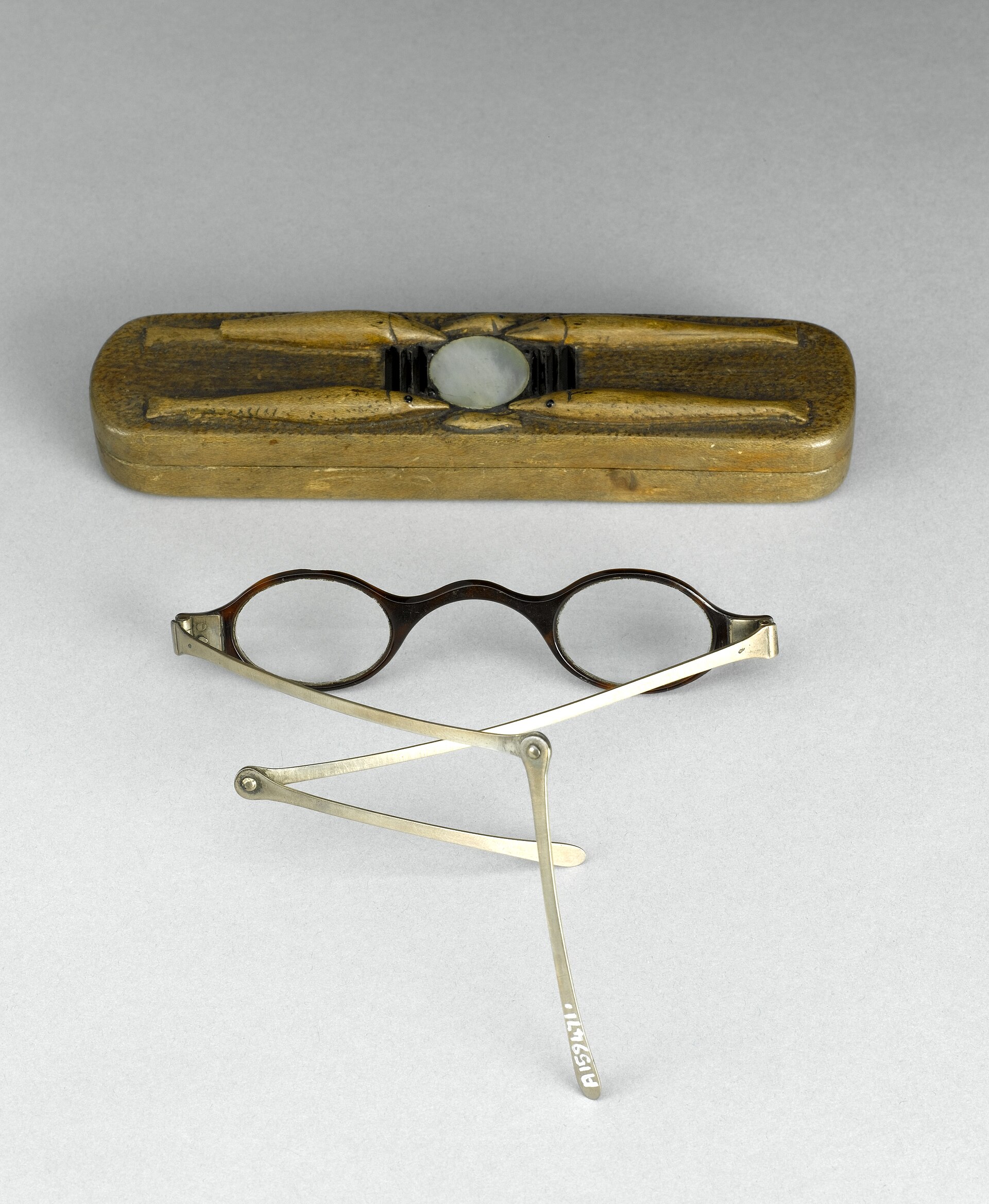

What actually defines a wayfarer, shape-wise?
Strip away the branding and the shape has a fairly consistent set of features that any frame described as a “wayfarer style” should show:
- A trapezoid outline — noticeably wider across the top than the bottom.
- Thick, flat brow line that sits high and reads almost like a separate bar.
- A slight upward kick at the outer top corners rather than a straight edge.
- A keyhole or simple bridge, kept understated so it doesn’t compete with the outline.
- Chunky temples, usually the same thickness as the front, rather than tapering to something thin.
Variants exist — narrower “New Wayfarer”-style takes, metal-trimmed versions, folding versions — but the trapezoid and the flat brow are what make a frame legible as this shape rather than just a square or a rectangle. When two frames both claim the shape, that outline and the corner treatment are what to compare directly.
What materials were originally used, and what’s used now?
The original was made from a cellulose-based plastic that could be moulded thick without becoming heavy, and could carry the flat colours — glossy black, tortoiseshell, crystal — that became part of the design’s identity. That material lineage is still relevant. Most wayfarer-shaped frames today are cut or injection-formed from acetate, chosen for the same reasons: it holds saturated colour, it can be finished with a proper edge and bevel, and it doesn’t feel disposable in the hand the way a thin injection-moulded plastic does.
Cheaper interpretations of the shape sometimes swap acetate for injection-moulded plastic that looks similar at a glance but behaves differently over years of wear — it can feel lighter in a way that reads as flimsy rather than refined, and it tends to lose its shine faster. The difference between the two is worth understanding before comparing frames at similar price points; acetate versus injection-moulded plastic sets out what actually separates them, and why good frames use acetate goes into what the material is doing structurally, not just cosmetically.
Does the wayfarer actually suit every face?
Styling convention — not science — holds that the trapezoid works especially well on rounder or softer face shapes, because the flat top and squared corners add definition that a round face doesn’t naturally have. The same convention suggests it’s a harder sell on an already angular, longer face, where a shape with this much straight line can look like it’s fighting the bone structure rather than complementing it.
Both of those are starting points, not rules, and plenty of people wear the shape well against the “rule” simply because scale and colour matter more than the outline in isolation — a narrower cut in a lighter tortoiseshell reads completely differently to a wide, glossy black pair. Anyone weighing up whether the usual face-shape guidance is worth following at all should read whether face-shape rules for glasses actually hold up before treating any of it as fixed.
What should you check if you’re buying a wayfarer-shaped frame?
The shape is common enough now, in both optical and sun versions, that quality varies enormously between two frames that look nearly identical on a shelf. A few things are worth comparing directly rather than assuming from the outline alone:
- Material — acetate versus a lighter injection-moulded plastic, checked by weight and by how the edges are finished.
- Hinge type — a metal hinge with visible barrels tends to outlast a moulded plastic hinge under repeated folding.
- Proportion — how wide the top bar actually is relative to your own face width, since the shape can look substantial on some faces and oversized on others.
- For the sunglasses version specifically, the UV rating on the lens rather than how dark it looks.
That last point matters more than it gets credit for. A dark lens with no stated UV filter is worse than wearing no sunglasses at all, because the tint makes the pupil open wider while doing nothing to block UV, so more radiation reaches the eye rather than less. Protection comes from a labelled UV400 or 100% UVA/UVB rating, not from depth of tint or from price. How to tell if sunglasses are genuinely UV protective covers exactly what to look for on the label before buying any pair in this shape as sunglasses. For a broader run-through of what to weigh up before buying any frame at all, the guide to choosing glasses and sunglasses is the place to start.
Related reading
frames, lenses, fit and how eyewear actually works, What Is a “Forever” Frame, and Does It Exist?
The Designer Glasses publishes general information and style opinion, not professional advice. We are writers and enthusiasts, not opticians, optometrists or dispensing opticians. Nothing here interprets a prescription, recommends a lens power, or tells you whether you need correction — only an eye examination can do that. If your vision changes suddenly, or you have eye pain, flashes, new floaters or halos around lights, treat it as urgent and contact an eye care professional the same day. Sunglasses should carry a stated UV rating: a dark lens without UV filtering is worse than none at all.
Featured image: Photo by Unknown, source, CC BY 4.0