Pantoscopic tilt is the forward angle of a lens relative to the eye when a frame is worn — the top of the lens sits slightly further from the face than the bottom. It’s built into how a frame is fitted and adjusted, not something you’d notice at a glance, and it affects both how the lens performs optically and how the frame reads on the face.
What does pantoscopic tilt actually mean?
Picture a frame in profile. If the lens plane were perfectly vertical, it would run parallel to the face like a pane of glass held straight up. Pantoscopic tilt tips that plane forward at the bottom, so the lower rim angles in toward the cheek and the upper rim angles slightly away. It’s measured in degrees from vertical, and most frames carry some amount of it by default, built into the shape of the front and the angle where the temples meet the hinges.
It isn’t a flaw or an adjustment fault. A completely untilted lens, sitting bolt upright, is actually the exception rather than the rule in how glasses are designed to be worn.
Why does a frame need any tilt at all?
The eye doesn’t sit still and look straight ahead all day. In natural use, the gaze drops slightly for reading, screens, and most close tasks. Tilting the lens forward means it stays closer to perpendicular to the actual line of sight in that lowered position, rather than only being optically ideal for a dead-level stare that people rarely hold.
This matters because a lens performs best — clearest, least distorted — when light passes through it close to straight on. Off-axis viewing through a lens, even a well-made one, introduces some distortion at the edges. Pantoscopic tilt is one of several design factors, alongside base curve and lens decentration, that opticians and lens labs account for when fitting a prescription into a frame, so the finished pair performs the way it was designed to rather than the way it looks sitting flat on a shelf.
Can you see pantoscopic tilt just by looking at a frame?
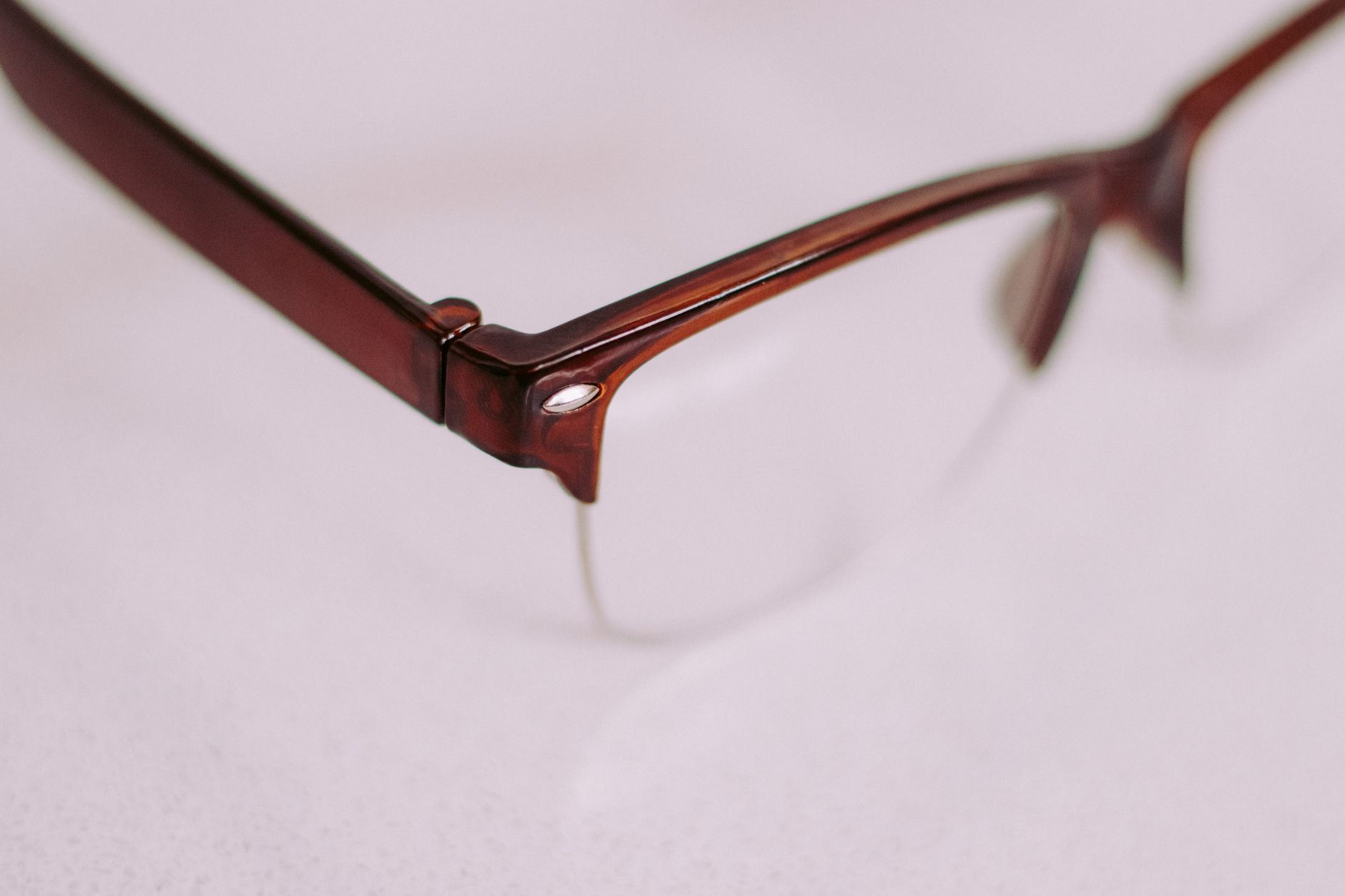
Not easily, and that’s the point — it’s a fitting parameter, not a visible style feature. What you can see is how a frame sits once it’s on a face: whether the temples run level, whether the front tips forward or sits bolt upright, and whether the lower rim looks like it’s crowding the cheek.
Temple length and the angle of the hinge both influence the resting tilt of a frame, which is one reason temple length matters more than most people assume. Nose pads play a role too, tipping the front forward or back depending on how they’re set, which is covered in more detail in what nose pads are for and when adjustable ones help.
Does pantoscopic tilt affect how a frame looks?
It does, even if the term itself stays invisible. A frame with more forward tilt tends to look like it’s leaning in slightly, which can read as a more directed, intent expression. A frame sitting more upright looks more neutral, sometimes slightly formal. Neither is right or wrong — this is a matter of taste, not correctness, and it’s one of the reasons the same frame shape can look completely different on two people even at an identical width.
This is opinion rather than science, and worth treating that way. The broader question of which conventions actually hold up is explored in whether face-shape rules for glasses actually hold up — tilt is one more variable that styling “rules” rarely account for, alongside frame width and proportion.
Does the wrong tilt cause discomfort or distortion?
If a frame’s tilt doesn’t suit the way it’s worn — too upright, too forward, or uneven from one side to the other — the lens stops sitting where it was designed to relative to the eye. That can show up as blur at the edges of vision, a sense of swimming when looking down, or lenses that never quite feel settled even though the prescription itself is correct.
It’s also tied up with basic mechanical fit. A frame that slides forward on the nose changes its own tilt as it moves, which is one of the reasons glasses that constantly slide down often feel optically off as well as physically loose. Distortion that shows up specifically at the edges of a lens has its own set of causes, discussed in what causes lens distortion at the edges of glasses, and tilt sits alongside base curve and decentration on that list.
Is pantoscopic tilt something to adjust yourself?
No. This is a fitting parameter that interacts with the specific lens design, the prescription, and how the frame sits on an individual face — it isn’t something to eyeball and bend into shape at home. Frames do need periodic adjustment as they loosen or shift, and how glasses should sit on the nose and ears covers what “correctly fitted” generally looks like day to day. But if a pair feels persistently off optically — not just loose, but genuinely hard to see clearly through — that’s a conversation for the person who fitted them, not a DIY project.
This isn’t a symptom in the urgent sense — persistent mild blur from a badly angled frame is a fit issue, not a medical one. But any sudden change in vision, eye pain, flashes, new floaters, or vision loss in one eye is a same-day matter for a professional, full stop, regardless of what the glasses are doing.
Does pantoscopic tilt matter more for certain lenses?
Yes. Lenses with a more complex surface — progressive lenses in particular, where the power changes gradually across the lens — are far more sensitive to exact positioning than a flat single-vision lens. Tilt, height, and pupil position all have to line up closely with how the lens was designed, or the usable zones for distance and near vision don’t land where the eye actually looks.
The difference between that kind of lens and a simpler design is explained in bifocal versus progressive lenses: what’s the real difference. The more sophisticated the lens, the more the fitting details — pantoscopic tilt included — stop being a nicety and start being part of whether the lens works at all.
What should you actually check when trying on a frame?
None of this needs to be measured by eye in a shop. What’s worth paying attention to is simpler and more visual:
- Whether the frame sits level, front-on and in profile, without one side dipping
- Whether it tips forward or leans back noticeably at rest
- Whether the temples run straight back to the ears without pressure points
- Whether the lower rim sits close to the cheek or well clear of it
These are fit and construction questions more than optical ones, and they’re worth judging in the same breath as width, bridge shape, and material. Browsing wider style questions — proportion against the face, or how different bridge and temple constructions behave — is covered across frames and styles and face shape and fit, both useful starting points before deciding a particular frame is the one worth having properly fitted.
The Designer Glasses publishes general information and style opinion, not professional advice. We are writers and enthusiasts, not opticians, optometrists or dispensing opticians. Nothing here interprets a prescription, recommends a lens power, or tells you whether you need correction — only an eye examination can do that. If your vision changes suddenly, or you have eye pain, flashes, new floaters or halos around lights, treat it as urgent and contact an eye care professional the same day. Sunglasses should carry a stated UV rating: a dark lens without UV filtering is worse than none at all.