Sunglasses should sit closer to the face and cover more of it than prescription glasses do. Everyday glasses are built for a clear, undistorted view straight ahead; sunglasses have a second job — blocking stray light and UV from the sides, above and below — which means more wrap, less gap, and a slightly tighter overall fit than you’d want for daily wear.
That difference sounds small until you put the two side by side. A pair of prescription glasses chosen for reading, screens or general wear is optimised for optical clarity through the centre of the lens. Sunglasses are optimised for coverage as much as clarity — keeping light out is part of the function, not a side effect of it.
Why does fit matter more for sunglasses than for everyday glasses?
Because gaps let light in. Any space between the frame and your face — at the brow, the temple, or below the lens — is a route for unfiltered light to reach the eye from the side, which is exactly what a well-fitted sunglass frame is meant to prevent.
With clear lenses, a small gap barely registers. With tinted lenses, it matters more, because the lens has already told your pupil to open wider. If UV is then arriving unfiltered through a gap at the temple, that widened pupil lets more of it in, not less. This is the same reasoning behind one of the most important facts in eyewear: a dark lens without a stated UV rating is worse than no sunglasses at all, because darkness without filtration opens the eye up rather than protecting it. The rating to look for is UV400 or a stated 100% UVA/UVB block — read more on how to tell if sunglasses are genuinely UV protective.
How should sunglasses sit on the face compared with prescription glasses?
Sunglasses should sit slightly closer to the face and higher on the bridge of the nose than most everyday frames, with less daylight visible between the lens edge and the cheek or brow. Prescription glasses are usually fitted a touch further from the eye for comfort and lash clearance.
The mechanics of that fit are the same set of contact points either way — nose pads or bridge, the top of the ears, and the curve of the temple. If you’ve never thought about why glasses sit where they do, how glasses should sit on the nose and ears is a useful primer before applying sunglasses-specific adjustments on top of it.
Two practical differences follow from that closer fit:
- Nose pads on sunglasses often sit slightly lower and tighter than on prescription frames, to stop the frame drifting down during activity in heat or sweat.
- Temple arms tend to have more curve behind the ear, since sunglasses are more likely to be worn during movement — walking, driving, sport — where a looser prescription fit would slip.
If a pair constantly slides down your nose regardless of style, that’s worth diagnosing on its own terms rather than assuming it’s a sunglasses problem — see what it means when glasses slide down constantly.
Does the frame need to be wider or bigger for sunglasses?
Not necessarily bigger overall, but coverage matters more than for prescription glasses. A frame that’s well-proportioned to your face width in the conventional sense can still under-cover if the lens is shallow or the temple sits too far from the skin at the sides.
Frame width relative to face is worth understanding in general terms before applying it to sunglasses specifically — how wide a frame should be relative to your face covers the baseline proportions. For sunglasses, the added consideration is depth and side coverage, not just the horizontal measurement across the front.
Temple length plays a bigger role here too. A temple that’s fractionally too long changes how the frame sits on the ear and, for sunglasses, can open a gap at the hinge that lets light in from the side. What temple length is and why it matters applies to both types of eyewear, but the margin for error is smaller with tint involved.
What does a wrap frame do that a flat frame doesn’t?
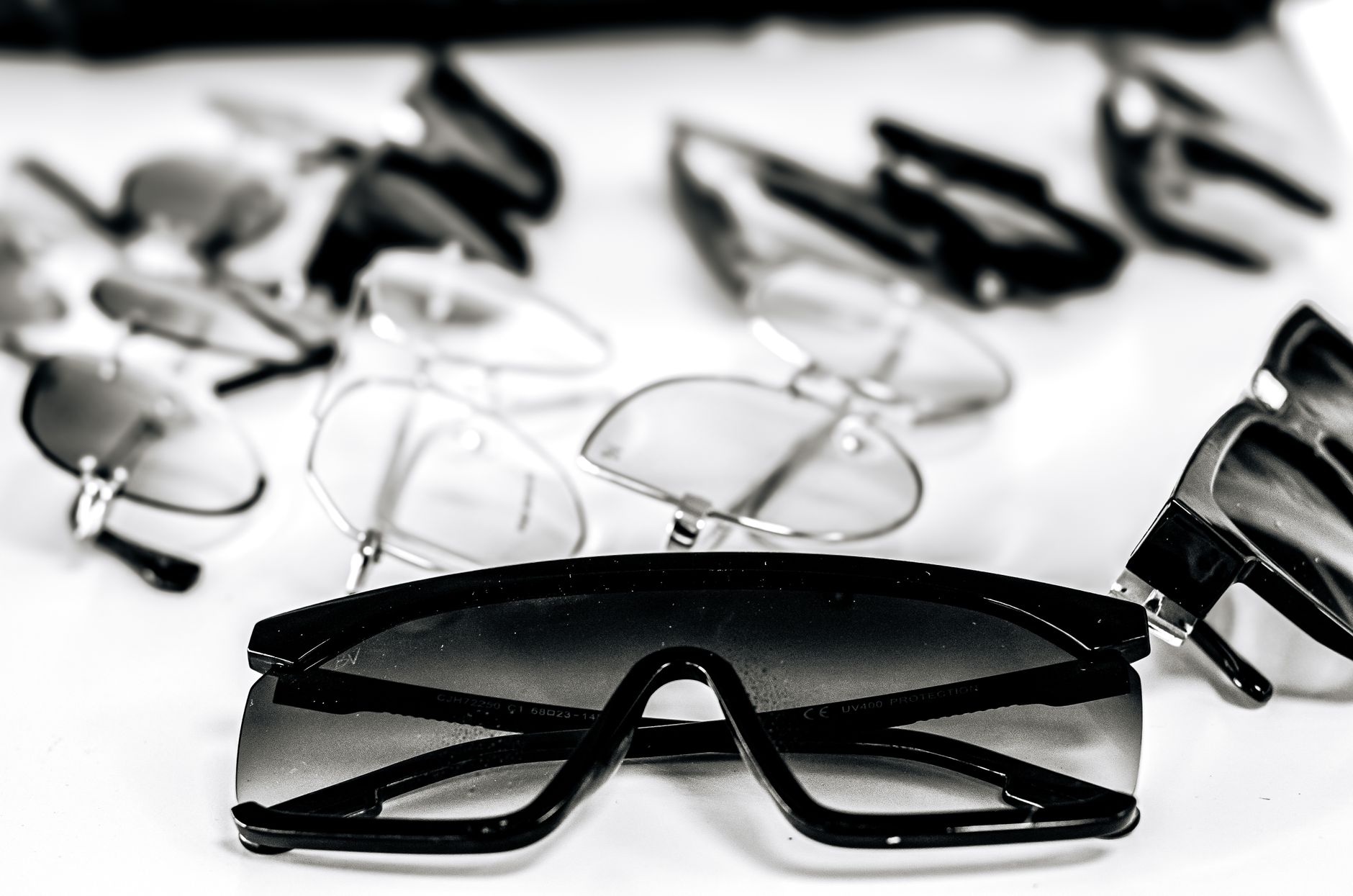
A wrap frame curves around the temple to close the side gap almost entirely, cutting down peripheral light and glare that a flatter, more rectangular front can’t fully block. It’s a construction choice specific to sunglasses — you rarely see true wrap geometry on prescription-only frames.
That curve isn’t purely functional styling, either — it changes the whole silhouette of the frame, and it changes how a lens behaves optically at the edges, since a curved lens surface interacts with the base curve of the lens itself. For the mechanics of that shape, see what a wrap frame is and what problem it solves. Sports-specific sunglasses tend to push this furthest, for reasons that go beyond fashion — what sports sunglasses are built differently for covers that ground.
Do prescription sunglasses fit the same as regular sunglasses?
Prescription sunglasses are fitted the same way as any sunglasses — close, with attention to coverage — but the lens itself has more constraints, since it has to carry a correction as well as a tint and a curve. That can limit how aggressively wrapped the frame can be before the optics start to distort at the edges.
This is one area where it’s worth understanding the trade-offs rather than assuming any frame shape will take any prescription equally well. An optician is the right person to say whether a specific prescription suits a strongly curved sunglass frame — that’s an optical calculation, not a styling one. For the general difference between having sunglasses made to prescription and using clip-ons over existing glasses, see prescription sunglasses versus clip-ons.
Frame construction is also worth comparing directly rather than by price or brand name, since coverage, hinge quality and lens mounting all vary independently of cost — the archive on materials and craft is a useful place to understand what to look for in the build itself.
Does face shape guidance change for sunglasses?
The general styling conventions — rounder frames for angular faces, more structured shapes for softer ones — still apply loosely to sunglasses, but coverage and proportion matter more than they do for prescription glasses, because a larger portion of the face is obscured either way.
These are conventions, not rules, and treating them as fixed is one of the more common mistakes in eyewear writing. Whether face-shape rules for glasses actually hold up is worth reading before taking any “which shape suits which face” advice too literally — plenty of people look better ignoring it. The broader category on face shape and fit covers proportion questions in more depth for readers who want the full picture rather than a single rule of thumb.
One genuine difference: because sunglasses sit closer and cover more, an oversized shape reads differently on sunglasses than it does on clear glasses of the same size. The same frame that looks aggressive in a clear acetate can look entirely ordinary once it’s tinted, because tint reduces how much of the eye and brow structure remains visible.
What should parents check differently for children’s sunglasses?
Children’s sunglasses need the same close, gap-free fit as an adult pair, but growing faces make it harder to get a lasting fit from a single frame, and comfort against still-developing skin around the nose and ears matters more than style. What to look for in sunglasses for a child goes into what actually matters at that age, beyond appearance.
Does a tighter sunglasses fit cause its own problems?
A closer fit can cause pressure at the nose and behind the ears if the frame is tightened for coverage without attention to how it actually contacts the skin. That’s a fit and adjustment issue rather than a reason to avoid a close-fitting frame altogether.
If a pair leaves marks or a persistent ache after wear, that’s usually fixable rather than something to live with — see why glasses leave marks on your nose and what causes glasses to pinch behind the ears. Sunglasses headaches have their own separate causes too, some to do with fit and some to do with the lens itself — why some sunglasses give you a headache covers both.
What should you actually check when trying sunglasses on?
Rather than judging fit on how a frame looks in a mirror alone, check for gaps at the brow and temple, confirm the frame doesn’t shift when you tilt your head, and make sure the arms don’t press hard enough behind the ear to feel it within a minute of putting them on.
- Look for light leaking in at the top or sides when facing a bright window — that’s the coverage gap a well-fitted sunglass frame should close.
- Check the nose pads or bridge sit without sliding on their own; sunglasses are worn in more heat and movement than everyday glasses.
- Confirm any tint has a stated UV rating — UV400 or 100% UVA/UVB — printed on the lens, the packaging or the manufacturer’s documentation, not just a dark appearance.
Frame fit standards can also differ between manufacturers in ways that have nothing to do with your face shape — bridge width and temple geometry vary by design lineage, something covered in standard versus Asian fit frames. It’s worth knowing this exists before assuming a fit issue is really about proportion.
None of this replaces a proper fitting. An optician or a good independent optical shop can adjust nose pads, temple curve and overall fit in ways that make a genuine difference to comfort and coverage — and for anything involving a prescription lens in a sunglasses frame, that adjustment is part of getting the optics right, not just the look.
The Designer Glasses publishes general information and style opinion, not professional advice. We are writers and enthusiasts, not opticians, optometrists or dispensing opticians. Nothing here interprets a prescription, recommends a lens power, or tells you whether you need correction — only an eye examination can do that. If your vision changes suddenly, or you have eye pain, flashes, new floaters or halos around lights, treat it as urgent and contact an eye care professional the same day. Sunglasses should carry a stated UV rating: a dark lens without UV filtering is worse than none at all.