Glasses leave marks on your nose because the frame’s weight is concentrated into two small points of contact — the nose pads or the bridge — for hours at a time. The skin there is thin, over bone and cartilage, so even light, steady pressure shows up as a dent, a red patch, or eventually a shiny, slightly darker groove.
What is actually causing the mark?
It’s pressure held in one place for a long time, not anything wrong with your skin. A frame that weighs almost nothing still applies force through a contact area of only a few millimetres. Multiply that small area by eight or ten hours of wear and the skin compresses, blood flow to the area briefly reduces, and a visible mark forms — the same way a sock leaves a line at the ankle.
Three things decide how bad it gets:
- How much the frame and lenses weigh, and where that weight sits.
- How much surface area the nose pads or bridge spread that weight across.
- How warm and humid the skin gets underneath — sweat softens skin and makes it more prone to indentation and irritation.
Why do some frames leave marks and others don’t?
Frames that distribute weight over a wider, softer contact area tend to mark less than frames that concentrate it into a hard edge. This is largely down to bridge design and pad type, not the price of the frame.
A saddle bridge, for instance, rests weight along a broader strip of the nose rather than two isolated points, which is one reason it’s associated with comfort on longer wears. A saddle bridge works differently to a pair of separate, moulded nose pads, and the two aren’t interchangeable in how they feel by the end of a day. Keyhole and double-bridge styles change the contact geometry again — worth understanding if you’re comparing frame shapes rather than just picking on looks.
Do nose pads make it better or worse?
Adjustable nose pads can genuinely reduce marking, because they can be angled to match the slope of your nose rather than forcing your nose to match the frame. Fixed pads, moulded as part of the plastic, can’t be tuned this way and rely entirely on the frame being the right fit from the start.
The material of the pad matters too. Silicone grips well and spreads pressure but can trap heat and moisture against the skin. Harder acetate or metal pads feel cooler but concentrate force more narrowly unless they’re shaped generously. There’s a genuine trade-off here, and it’s covered in more depth in what nose pads are for, and when adjustable ones actually help.
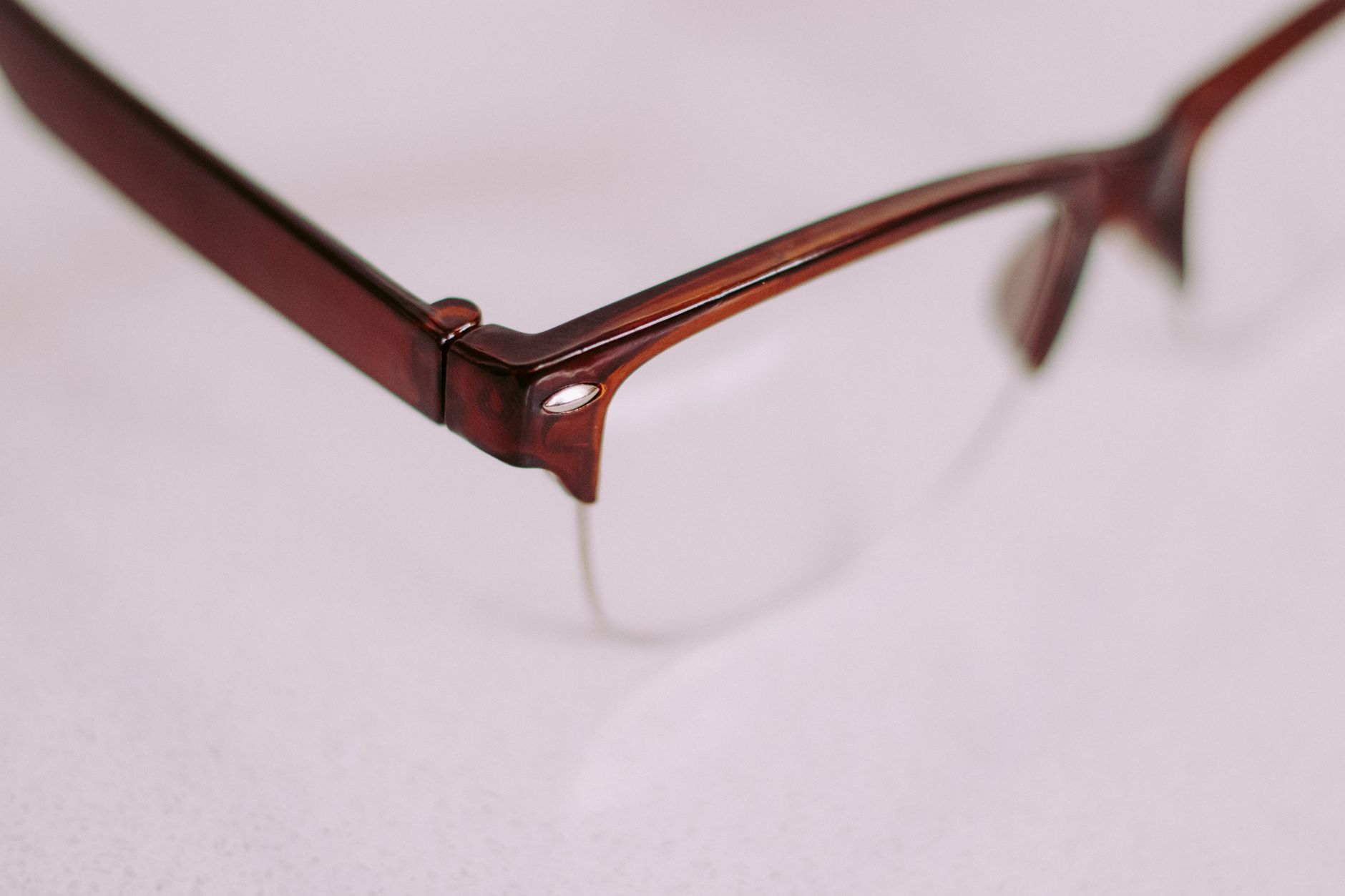
Does the weight of the frame matter more than people think?
Yes — weight is often the single biggest factor, and it’s easy to underestimate because a frame that feels light in the hand can still feel heavy after ten hours on the face. Lens material contributes more to this than most people expect. Thicker, higher-index lenses or larger lens shapes add weight at exactly the point furthest from the ears, which increases the load pressing down through the bridge.
This is one reason lens material choice is a styling decision as much as a technical one. The trade-offs between weight, thickness and clarity are explained in Materials & Craft, and are worth understanding before assuming a mark is simply “how glasses are.”
Is it about how the glasses sit, not just the frame itself?
Often, yes. A frame that’s well made can still mark the skin badly if it isn’t sitting correctly — tilted forward, resting too low, or pressing unevenly because one side sits higher than the other. Marks that appear on only one side of the nose usually point to a fit problem rather than a design flaw in the frame.
How the frame should actually sit — level, resting on the broadest part of the nose, weight shared between nose and ears rather than nose alone — is set out in how glasses should sit on your nose and ears. If the frame is also sliding constantly, that’s a related but separate issue, covered in what it means when glasses keep slipping down — a frame that slides is usually also a frame that’s marking the skin more than it should, because you keep pushing it back up.
Can nose marks mean the frame is simply the wrong fit?
Marks that are deep, one-sided, or that come with visible red pressure lines across the bridge rather than at the sides usually mean the frame is too narrow, too heavy for its width, or shaped for a different nose bridge profile than yours. This is a proportion problem, not something adjustment alone always fixes.
Frame width relative to your face is one part of this — a frame that’s slightly too narrow across the front pulls the temples inward and increases pressure at the nose to compensate. That relationship is explained in how wide a frame should be relative to your face. Bridge and nose-pad shape are also built differently across ranges for exactly this reason, which is what standard and Asian-fit frame construction addresses — worth reading if a frame consistently rides too low or bites at the bridge no matter how it’s adjusted, in standard vs Asian-fit frames.
Is it ever a skin problem rather than a fit problem?
Usually not, but occasionally. A mild indentation that fades within an hour of removing the glasses is completely ordinary. Redness, itching, or a rash that spreads beyond the contact points is more likely a reaction to a specific material — nickel in some metal frames is a known trigger — and is worth mentioning to a pharmacist or GP if it persists, since that’s a skin question rather than a frame one.
None of this is an eye health matter. It’s about skin under sustained contact, and it sits outside anything an optician needs to examine for vision reasons — though an optician can absolutely help with the fit itself.
What can actually be done about it?
Most nose marking is fixable without buying a new frame:
- Have the nose pads or bridge angle adjusted so the frame’s weight lands across a wider area rather than two sharp points.
- Check that the frame sits level and isn’t tilted forward from the bridge.
- Consider whether the lenses are adding unnecessary weight for the frame size — this is a lens-material conversation, not just a frame one.
- If the frame is a fixed-pad style and consistently marks the skin, an adjustable-pad version of a similar shape may suit the same face better.
Small adjustments here tend to matter more than the frame’s price or brand. Proportion, pad type and where the weight actually sits are the things worth comparing on any pair before deciding a mark on the nose is simply unavoidable — it usually isn’t.
The Designer Glasses publishes general information and style opinion, not professional advice. We are writers and enthusiasts, not opticians, optometrists or dispensing opticians. Nothing here interprets a prescription, recommends a lens power, or tells you whether you need correction — only an eye examination can do that. If your vision changes suddenly, or you have eye pain, flashes, new floaters or halos around lights, treat it as urgent and contact an eye care professional the same day. Sunglasses should carry a stated UV rating: a dark lens without UV filtering is worse than none at all.