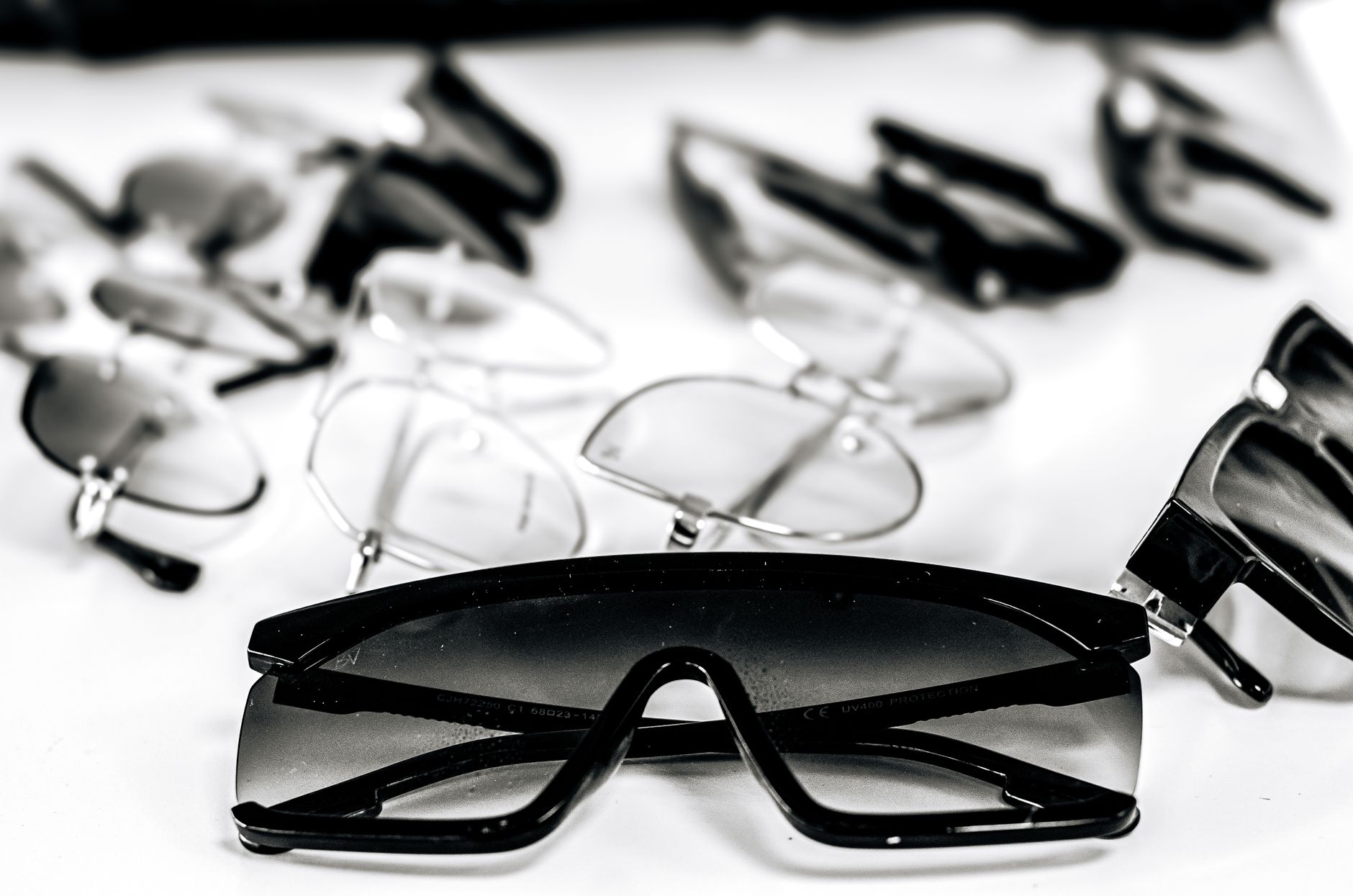
You tell by the label, not the lens. Genuine UV protection is stated explicitly — as “UV400” or “100% UVA/UVB protection” — printed on the lens, the arm, or the swing tag. If that wording isn’t there, the tint tells you nothing about UV filtering at all, no matter how dark or expensive the sunglasses look.
What does a UV400 label actually guarantee?
UV400 means the lens filters light up to a wavelength of 400 nanometres, which covers the UVA and UVB range that reaches the eye. It’s a filtering claim, not a darkness claim, and it has nothing to do with the lens colour.
The number itself is a wavelength cut-off, not a percentage or a grade of quality. A clear lens can carry a genuine UV400 rating; a near-black lens can carry none at all. For a longer explanation of what the rating covers and doesn’t, the piece on what a UV400 rating actually means goes through it in more depth.
Why is a dark lens not the same thing as UV protection?
Because tint and UV filtering are two separate properties that happen to sit in the same piece of plastic or glass, added by different processes for different reasons. A lens can be tinted almost black and still let UV straight through, and a lens can be barely tinted at all while blocking it completely.
This matters more than it sounds, because a dark lens with no UV filter is worse than wearing nothing. The eye reads the dim light and dilates the pupil to let more light in — which also lets more UV in, unfiltered, straight to the retina. Bare-eyed in daylight, the pupil stays smaller and takes in less. This is covered properly in why dark lenses without UV protection are worse than none, and it is worth reading before buying anything from a market stall or a pair with no paperwork at all.
Does the price of the sunglasses tell you anything about UV protection?
No. UV filtering additives are cheap and standard across the industry, so a genuinely UV400-rated lens can appear on frames at almost any price point. Cost buys frame material, hinge construction, lens clarity and brand — not a guarantee of UV filtering that a budget pair lacks.
What separates cheap and expensive sunglasses is explored properly in whether expensive sunglasses protect eyes better, and the short version holds here too: check the label, not the receipt.
Can you check UV protection yourself, without a lab?
Not reliably with the naked eye, no. There’s no visible cue — colour, weight, reflectiveness, brand marking on the frame — that correlates with a UV filter being present. The only trustworthy check is the printed claim, ideally referencing a named standard rather than vague marketing language.
- Look for “UV400” or “100% UVA/UVB protection” printed on the lens or arm.
- Look for a reference to a recognised standard, such as ISO 12312-1 for sunglasses, on the packaging or documentation.
- If buying online, check the product description explicitly states a UV rating rather than just describing the tint or the category number.
- If there’s genuinely no claim anywhere, treat it as unrated and choose something else.
Opticians and some optical retailers can test a lens for UV transmission with dedicated equipment, which is the only way to verify a pair with no labelling at all — worth doing if the sunglasses matter enough to keep, or if they’re for a child, where choosing sunglasses for a child raises the stakes on getting this right.
Does polarisation mean the lens blocks UV?
No, and this is one of the most common mix-ups in eyewear. Polarisation cuts glare — the specific, blinding reflection off flat surfaces like water, glass and tarmac. UV filtering is a completely separate additive that has nothing to do with the polarising film.
A lens can be polarised without carrying any UV rating, and a UV400 lens can have no polarisation at all. The two are sold together often enough that people assume one implies the other. It doesn’t. UV protection vs polarisation sets the distinction out properly, and what polarised lenses actually do is useful if the glare-cutting side of the lens is the part in question rather than the UV side.
Does a darker lens category mean stronger UV filtering?
No — lens categories describe how much visible light gets through, on a scale from 0 to 4, and say nothing about UV filtering on their own. A category 4 lens is very dark and unsuitable for driving; a category 1 lens is barely tinted. Neither number implies a UV rating either way.
The category number and the UV rating are printed separately because they measure different things entirely. Sunglass lens category numbers, explained covers what the 0–4 scale actually means and why it’s not a substitute for checking UV separately.
Does frame shape or coverage affect UV exposure?
Partly, yes — UV reaches the eye from the sides and underneath as well as straight on, and a small or very open frame lets light in around the lens no matter how well the lens itself filters it. Larger lenses and closer-fitting frames reduce that peripheral exposure; the filtering of the lens itself still does the actual work.
This is one of the few places where fashion and function point the same way. A close-fitting wrap-style frame, built to sit nearer the face and curve around the temple, is specifically designed to close off that side gap — worth understanding via what a wrap frame is and the problem it solves if outdoor coverage matters more than a flat, retro profile. Neither shape substitutes for a genuine UV rating; both need it stated to actually do the job.
What should you check before buying a pair?
The reliable order is: confirm the UV claim first, then judge everything else — tint, polarisation, category, shape — as separate decisions on top of that baseline. None of the second group compensates for the first being missing.
- Confirm a UV400 or 100% UVA/UVB claim is printed somewhere on the product, ideally with a named standard.
- Treat tint darkness and lens category as a comfort and glare choice, not a protection choice.
- Treat polarisation as a separate, optional feature for glare, not a proxy for UV filtering.
- Consider frame coverage — how close the lens sits to the face and how much side gap there is — as a secondary factor, not the main one.
- If there’s no UV claim anywhere on the sunglasses, assume there is no filtering and choose a different pair.
Everything past that point is styling and construction — the kind of detail covered across the sunglasses archive and the lenses and coatings archive — but it’s worth getting the UV question settled first, since it’s the one thing tint, price and appearance genuinely cannot tell you.
The Designer Glasses publishes general information and style opinion, not professional advice. We are writers and enthusiasts, not opticians, optometrists or dispensing opticians. Nothing here interprets a prescription, recommends a lens power, or tells you whether you need correction — only an eye examination can do that. If your vision changes suddenly, or you have eye pain, flashes, new floaters or halos around lights, treat it as urgent and contact an eye care professional the same day. Sunglasses should carry a stated UV rating: a dark lens without UV filtering is worse than none at all.