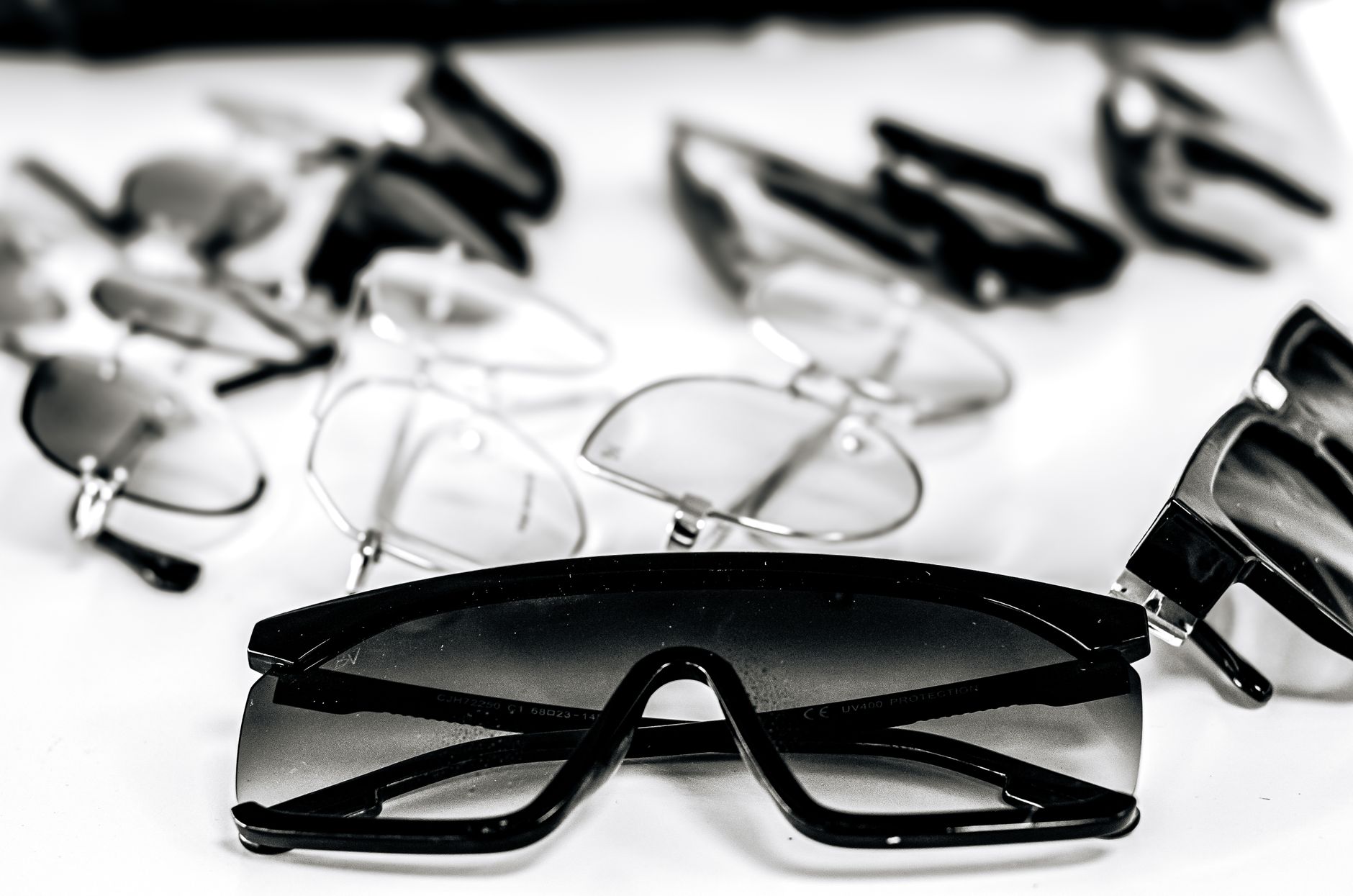
A dark lens without a UV filter tricks the eye into staying more open than it would in daylight, because the tint tells the pupil it’s dim. Without UV blocking, that wider pupil lets in more ultraviolet light than if no sunglasses were worn at all. The darkness is the problem, not the protection.
How can sunglasses make UV exposure worse?
The eye reacts to brightness, not to ultraviolet light directly. Behind a dark lens, less visible light reaches the retina, so the pupil dilates to compensate, exactly as it would at dusk. If that lens has no UV filter, the ultraviolet light streams straight through the widened pupil unaffected by the tint at all.
Take the tint away and the eye behaves normally in bright conditions: the pupil constricts against the glare, naturally limiting how much light, UV included, gets in. So an unfiltered dark lens does not sit between the eye and the sun as a shield. It removes the eye’s own defence mechanism while doing nothing to replace it.
Why doesn’t a darker lens mean more protection?
Tint depth and UV filtering are two separate things, applied separately, and one tells you nothing about the other. A lens can be barely tinted and carry full UV protection, or be almost black and carry none. Colour and depth are cosmetic and optical choices about glare and contrast; the UV filter is a chemical treatment or coating layered in separately.
This is worth repeating because it runs against instinct: the assumption that “darker must mean safer” is exactly the trap. Manufacturers are not obliged to disclose UV performance on cheap or novelty sunglasses, and a lens with no stated rating should be treated as unprotected, however black it looks.
What does a UV rating actually look like on a label?
Genuine protection is stated, not implied. Look for “UV400” or wording such as “100% UVA/UVB protection” printed on the lens, the frame, or the swing tag. UV400 refers to blocking light up to the 400-nanometre wavelength, which covers the UVA and UVB range relevant to the eye. There’s a fuller explanation of what that number is actually measuring on what a UV400 rating actually means on sunglasses, which is worth reading before buying anything for genuine sun use.
A rating tied to a named standard, rather than a vague claim like “UV protective,” is the more trustworthy signal. If a pair has no marking at all and the seller can’t confirm one, treat that as a pair of tinted lenses, not sunglasses.
Does this apply to prescription sunglasses too?
Yes, and it’s easy to overlook because the focus tends to be on the prescription itself. A tinted prescription lens needs the same UV filter as any other sunglasses lens; correction and sun protection are unrelated properties that both happen to sit in the same piece of glass. Whether a particular prescription needs a tint, a photochromic option, or anything else applied to it is a question for an optician, not something to work out from styling advice.
What can be judged without any clinical knowledge is whether the finished pair states a UV rating. If it doesn’t, ask before buying, regardless of how the prescription itself reads.
What about blue-light filtering — is that the same kind of protection?
Not really, and it’s worth being straightforward about it. Blue-light lenses are marketed heavily around screen use and eye strain, but the evidence that filtering blue light from screens changes comfort or long-term eye health in any meaningful way is thin. That doesn’t make the lenses harmful or pointless to choose, but it’s a different claim from UV protection, which has a defined standard and a clear mechanism behind it. Treat blue-light marketing as a preference, not a proven safeguard.
What if eyes already feel sore or sensitive after time in strong sun?
Eye pain, sudden light sensitivity, blurred or reduced vision, new floaters, flashes of light, or vision loss in one eye are not things to wait out or self-diagnose. These are same-day matters for an eye care professional, sunglasses or no sunglasses. Nothing in this article should be read as reassurance if any of those symptoms are present.
How should protection actually be checked before buying?
The tint should never be the test. A few checks matter more:
- Look for a printed UV400 or 100% UVA/UVB statement on the lens or packaging.
- Be wary of festival stalls, market stands, or unbranded stock with no documentation at all.
- Don’t judge protection by how dark the lens appears when held up to a window; that tells you about visible light transmission, not UV filtering.
- If buying prescription sunglasses, confirm the UV filter is applied to the finished lens, not assumed from the frame brand.
None of this is about price. An expensive frame with beautiful acetate and hand-polished edges can still carry an unfiltered lens if nobody asked. Price buys design and material quality — covered in more depth in what actually makes a frame look expensive — not automatically UV performance.
Does frame shape or size change how much protection is needed?
Coverage is a separate but related consideration. A larger lens or a wraparound shape blocks more peripheral light reaching the eye from the sides, which matters alongside the UV filter itself, not instead of it. This is one reason oversized shapes have stayed popular for genuine sun use rather than just as a styling statement — there’s more on that trade-off in what an oversized frame does to face proportions.
Classic shapes like the aviator were originally developed with coverage and glare in mind before they became a style category in their own right; the reasoning behind that shape is worth a look in what an aviator frame actually is and why it was designed that way. Frame construction also plays a role: how much the lens and rim shield the eye differs across full rim, half rim and rimless builds, since a rim can add a fractional amount of shade at the edge where a rimless mount can’t.
Where does styling fit once protection is sorted?
Once UV protection is confirmed, everything else is genuinely a matter of taste, and this is where sunglasses get interesting rather than clinical. Tint colour changes contrast and mood as much as it changes how dark something looks; the broader question of how colour choices read on the face is explored in how frame colour changes how glasses read. Shape and proportion are worth browsing properly rather than defaulting to whatever’s on the shelf nearest the till — the full range is in the sunglasses archive and the wider frames and styles archive.
The point of a good pair of sunglasses is that it does both jobs at once: it protects the eyes properly, without anyone needing to think about it, and it looks like it was chosen on purpose. A dark lens with no UV filter fails at the first job while pretending to succeed at it, which is precisely why it earns a worse verdict than wearing nothing at all.
The Designer Glasses publishes general information and style opinion, not professional advice. We are writers and enthusiasts, not opticians, optometrists or dispensing opticians. Nothing here interprets a prescription, recommends a lens power, or tells you whether you need correction — only an eye examination can do that. If your vision changes suddenly, or you have eye pain, flashes, new floaters or halos around lights, treat it as urgent and contact an eye care professional the same day. Sunglasses should carry a stated UV rating: a dark lens without UV filtering is worse than none at all.