Prescription sunglasses are a single lens, ground to your prescription and tinted or coated at the factory, sitting in one frame you wear on their own. A clip-on is a second, separate tinted lens that attaches to the front of glasses you already own. The correction lives in your everyday glasses; the clip-on only adds tint on top.
What exactly is a pair of prescription sunglasses?
A prescription sunglass lens is made the same way as any prescription lens — ground and shaped to a specific correction — except the lens blank itself carries a tint or a coating from the start. It’s one object: one lens, one frame, built to do both jobs at once.
Because the tint is part of the lens material or a coating fused to it, the optics and the sun protection are considered together during manufacture. The lens can also carry a stated UV filter, a polarising layer, or a gradient effect, and these can be built in without adding a second surface for light to bounce around in. For background on how those coatings and tints actually work, the Lenses & Coatings section covers what each one does.
What is a clip-on, and how does it actually work?
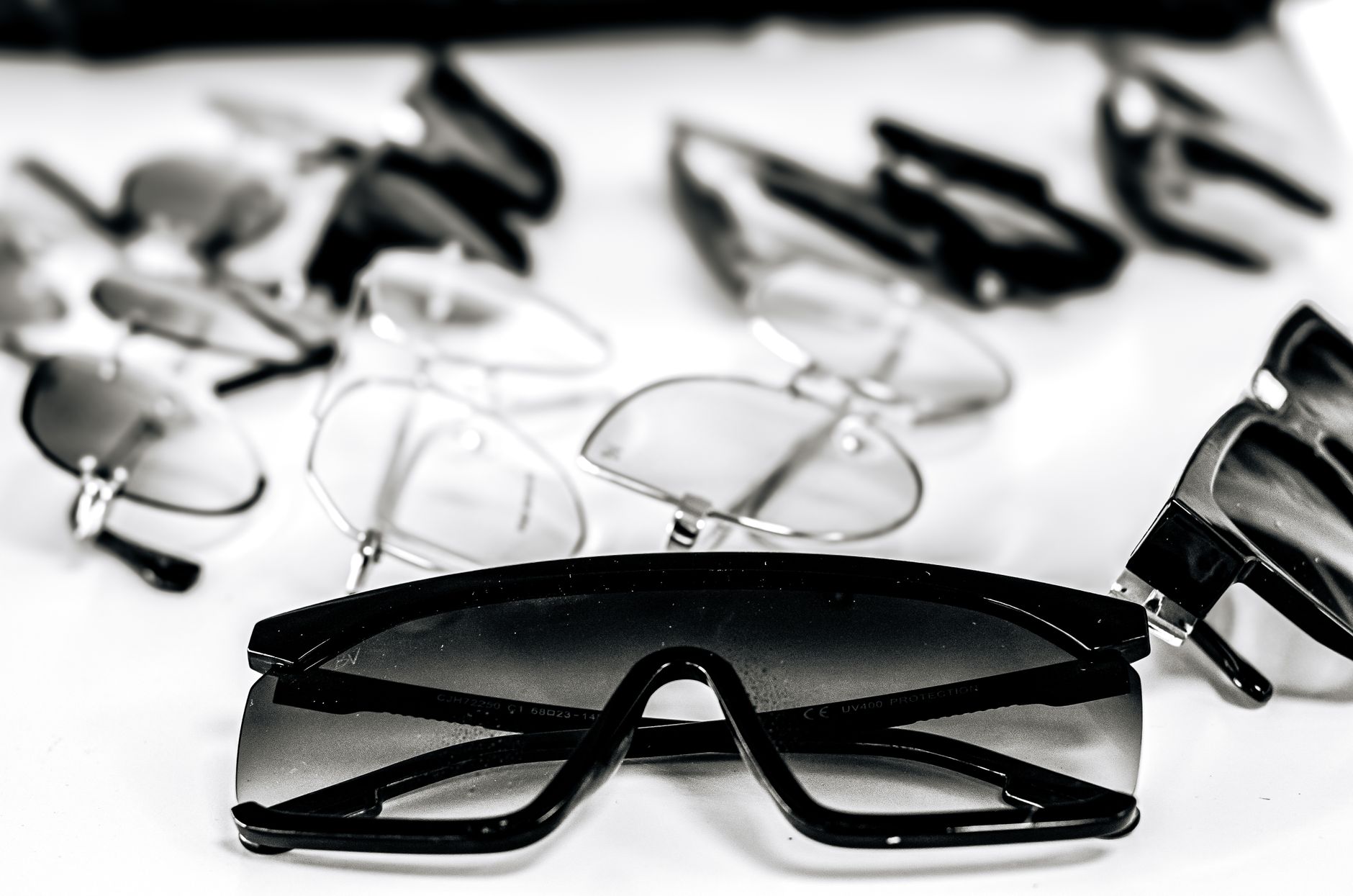
A clip-on is a shaped, tinted lens — usually held by small spring clips, a magnetic strip, or a bar that grips the top of the frame — that fastens onto a pair of ordinary prescription glasses. It sits a few millimetres in front of your actual lenses.
Nothing about the clip-on itself is ground to a prescription. It’s simply a tint, shaped to roughly match the outline of the frame underneath. The correction still comes entirely from the glasses behind it. Take the clip-on off, and you’re back to your regular indoor pair; put it on, and the same lenses are now behind a layer of tint.
Do clip-ons correct vision as well as prescription sunglasses?
Yes, in the sense that the correction underneath is unchanged — it’s the same lenses you wear every day. What changes is optical quality overall: adding a second lens surface in front of the first can introduce reflections, slight distortion at the edges, or a faint doubling of images, especially with cheaper clip-ons or wraparound shapes.
A dedicated prescription sunglass lens has no second surface to contend with. The correction and the tint are one piece of glass or polymer, so there’s nothing extra for light to pass through or bounce off before it reaches the eye.
Where do clip-ons fall short on sun protection?
This is the part worth being careful about. A clip-on is only as good as its own UV filter — it does not inherit protection from the prescription lens behind it, and a dark tint alone tells you nothing about that filter.
Darkness and UV protection are two separate things. A very dark lens without a stated UV rating can be worse than wearing no sunglasses at all, because the tint makes the pupil open wider while offering no actual filter, letting more ultraviolet light reach the eye than it would in daylight. Genuine protection comes from a labelled filter — look for UV400 or a claim of 100% UVA/UVB protection — not from how dark the lens looks or what it cost. The UV400 rating explainer and the piece on why a dark lens without UV protection is worse than none both go into this in more detail, and it applies to clip-ons exactly as much as to any other sunglasses.
Cheap clip-on sets sold as generic accessories don’t always carry a UV rating at all. If a clip-on doesn’t state one, treat it as decoration rather than protection.
What about fit and how they look on the face?
A clip-on has to match the outline of the frame it’s attached to, which limits it to whatever shape that frame already is. It also adds a visible seam — a join line, a small gap, sometimes a slight forward tilt — that reads differently depending on the frame material and how snugly the clip sits.
Prescription sunglasses, by contrast, are their own frame entirely. That means real freedom of shape: a proper wrap for sport or driving, a heavier acetate for a rounder face, a slim metal frame if that’s the proportion that suits you. The frame doesn’t have to compromise between “what my everyday glasses look like” and “what works as sunglasses.” For the shape decisions that follow from that freedom, the Frames & Styles archive is a useful starting point, and the wrap frame piece explains why that particular shape shows up so often in dedicated prescription sunglasses and rarely in clip-on form.
Are magnetic clip-ons different from clip-on frames?
Magnetic clip-ons use small metal inserts fixed to the inside of the regular frame, with the tinted lens held on by magnets rather than spring clips. They tend to sit flatter and detach more cleanly, and they’re common on frames designed with this in mind from the start.
The underlying trade-off is the same either way. A magnetic system is neater and less fiddly than a clip-on gripping the frame edge, but it’s still a second lens in front of the first, and its sun protection still depends entirely on its own stated UV filter, not on the frame it’s attached to.
When does a clip-on genuinely make sense?
Clip-ons solve a real problem: needing sun protection occasionally, without paying for and carrying a second full pair of prescription glasses. They suit people who are mostly indoors, step outside briefly, and don’t want two frames in a bag.
- Occasional or unpredictable sun exposure rather than daily driving or long hours outdoors
- A single frame preferred for convenience, travel, or cost
- A frame shape that happens to be well suited to a clip-on attachment, with a stated UV rating on the clip itself
They’re a reasonable compromise for someone who mostly needs their glasses indoors and occasionally in bright light — not a substitute for proper sunglasses used for hours at a time, and not something to rely on for driving, where lens quality and glare handling matter more. The piece on what makes sunglasses suitable for driving is worth reading if that’s the main use case, since a clip-on’s extra surface can introduce exactly the kind of reflection and distortion that’s unhelpful behind a windscreen.
When are dedicated prescription sunglasses worth it?
They earn their keep with regular or extended outdoor use — walking, running, cycling, driving, or simply living somewhere bright for a large part of the year. A single, purpose-built lens avoids the optical compromises of a second surface, and the frame can be shaped properly for coverage, whether that’s a close-fitting wrap or something closer to a regular frame.
They’re also the better route if polarisation matters. A polarised lens is a filter built into the lens material to cut horizontal glare off flat, reflective surfaces like water, wet roads, or glass. Clip-ons can be polarised too, but stacking a polarised clip-on over an unpolarised prescription lens sometimes produces odd colour or contrast effects, particularly through certain windscreens or LCD displays. What polarised lenses actually do covers that filter in more detail, and it’s genuinely worth understanding before assuming polarising a clip-on solves everything.
Ill-fitting sunglasses of any kind — a clip-on that presses at the temple, a frame that’s slightly too tight across the bridge — are also a common, overlooked cause of headaches after wearing them for a while. That’s covered in why some sunglasses give you a headache, and it applies just as much to a clip-on riding awkwardly on a frame as to a full prescription sunglass pair that doesn’t fit properly.
How do you choose between them?
The decision comes down to how often the sun protection is needed and how much that use matters to daily life. A clip-on is a sensible stopgap for occasional glare. Dedicated prescription sunglasses are the better long-term choice for anyone outdoors regularly, anyone driving often, or anyone who simply wants sunglasses that look considered rather than borrowed.
Whichever route is chosen, the UV filter is non-negotiable — check for a stated UV400 or 100% UVA/UVB claim on the lens itself, whether that lens is a clip-on, a full prescription sunglass, or an off-the-shelf pair. The tint’s darkness has nothing to do with it. The Sunglasses archive has more on the specific lens and frame decisions that follow once that basic filter question is settled.
The Designer Glasses publishes general information and style opinion, not professional advice. We are writers and enthusiasts, not opticians, optometrists or dispensing opticians. Nothing here interprets a prescription, recommends a lens power, or tells you whether you need correction — only an eye examination can do that. If your vision changes suddenly, or you have eye pain, flashes, new floaters or halos around lights, treat it as urgent and contact an eye care professional the same day. Sunglasses should carry a stated UV rating: a dark lens without UV filtering is worse than none at all.