Most sunglasses headaches come from one of three things: a frame that squeezes the temples or nose too tightly, a lens with distortion the eyes keep trying to correct for, or a dark tint with no real UV filter forcing the pupil wide open in bright light. None of it means the sun is the enemy. It usually means the pair on your face is wrong for you.
Why do some sunglasses give you a headache?
The three usual causes are physical pressure from a poorly fitted frame, optical distortion in a cheap or warped lens, and a tint dark enough to dilate the pupil without a genuine UV filter behind it. Each produces a different kind of ache, and each has a different fix — none of which involves avoiding sunglasses altogether.
Could it just be the fit of the frame?
Yes, and this is the most common culprit by far. A headache that sits at the temples, or a dull band across the forehead, is usually mechanical, not optical.
Sunglasses that are too narrow clamp the temples against the head for hours. Frames that are too wide slide down and force the wearer to scrunch their brow to keep them in place. Nose pads that sit slightly off-centre put uneven weight on one side of the face, which shows up as a one-sided ache by the end of the day.
This is worth checking before blaming the lens at all. Look at where the pressure actually is. Temples that leave red marks, or arms that have to be bent outward just to clear the ears, are a sizing problem, not a sun problem. It’s also why the numbers stamped inside a frame — lens width, bridge width, temple length — are worth understanding rather than ignoring; they’re the quickest way to compare whether a new pair will actually sit the way an old favourite did. There’s more on reading those in our piece on what the numbers inside a glasses frame mean.
Is a dark lens without UV protection actually worse?
Yes. A lens that looks dark but carries no stated UV rating is worse than wearing no sunglasses at all, because the tint tells the pupil to open wider while doing nothing to filter the UV reaching the eye. That combination — more light let in, no filter on it — is a plausible source of eye strain and headache, on top of the exposure itself.
Protection comes from the coating, not the shade of grey or brown. Look for a label that says UV400 or 100% UVA/UVB protection. That rating has nothing to do with how dark the lens looks and nothing to do with what it cost — a pale lens with a proper UV400 rating is doing more for the eyes than a near-black lens with none. This is explained in full in why dark lenses without UV protection are worse than none and in what a UV400 rating actually means.
If a pair of sunglasses has no visible rating printed on the lens, arm, or accompanying tag, that’s a real gap, not a minor omission.
Does the lens colour or gradient matter?
Lens colour changes contrast and how colours appear, not how well the eye is protected. A tint that’s mismatched to the light — very dark grey on an overcast day, for instance — can make the eyes work harder to compensate, which contributes to strain over a long afternoon.
Gradient lenses, dark at the top and clear toward the bottom, exist to cut glare from overhead sun while keeping a dashboard or a book legible. Worn in the wrong situation — indoors, or in flat, overcast light — the mismatch between what the eyes expect and what they’re getting can be part of what causes a headache. Our guides on whether lens colour changes what you see and what a gradient lens is actually for go into where each tint earns its keep.
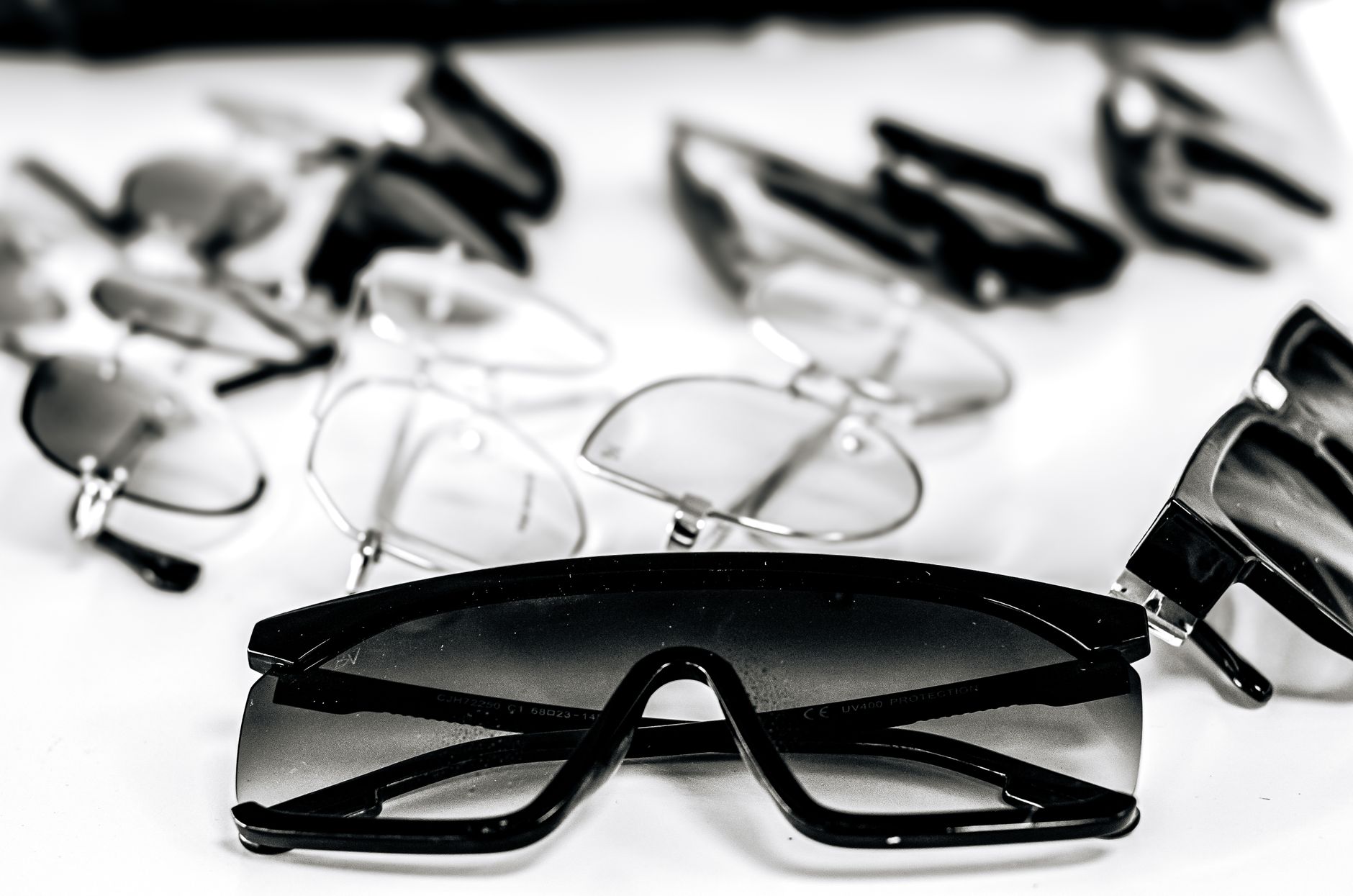
Can polarised lenses cause headaches?
For most people, no — polarised lenses cut glare and tend to be more comfortable in bright conditions, not less. But polarisation interacts oddly with certain LCD screens and instrument panels, producing rainbow patterns or patches that appear to go dark. Staring at that effect, or trying to read a screen through it, is a genuine source of strain for some wearers.
That’s a specific, situational issue rather than a general property of polarised lenses. It’s covered properly in what polarised lenses actually do and when polarised lenses are a bad idea.
Could the lens itself be poorly made?
Yes, and this is harder to spot than a bad fit because it isn’t about comfort on the face — it’s about what the eye is looking through. Cheaply moulded lenses can have subtle waves or inconsistencies in thickness that distort a straight line as the eye moves across the lens. The brain compensates for this constantly, and that ongoing correction is tiring in a way that’s hard to pin down.
A rough way to check: hold the sunglasses at arm’s length and look through them at a door frame or a line of tiles while moving the lens slowly across your view. If the line warps, swims or bends, the lens has distortion worth avoiding. This isn’t about price on principle — plenty of inexpensive lenses are optically clean, and plenty of expensive ones aren’t automatically better, a point covered in whether expensive sunglasses protect eyes better.
Does frame shape or coverage make a difference?
Frame shape affects how much stray light reaches the eye from the sides, above or below the lens, and that stray light is a real contributor to squinting and strain in bright conditions. A slim, flat frame lets light in around the edges even if the lens itself is doing its job.
Wraparound and semi-wrap frames close off that gap, which is exactly the problem they’re built to solve — worth reading about in what a wrap frame is and what problem it solves. It’s also part of why glare itself deserves its own explanation, since not all glare is treated the same way by every lens; see what glare is and which kinds sunglasses help with.
When is a headache actually something to take seriously?
A headache linked to sunglasses is usually about fit or optics and resolves once the pair is changed or removed. That’s different from a headache that arrives with sudden vision changes, eye pain, flashes of light, new floaters, halos around lights, or loss of vision in one eye. Those are same-day matters for an eye care professional, sunglasses or not, and this article isn’t the place to reason them away.
If a headache persists regardless of which sunglasses are worn, or worsens over weeks, that’s also a conversation for an optician rather than a frame swap — a change in how the eyes are focusing is a medical question, not a styling one.
How can you tell which pair is the problem?
A short process of elimination usually settles it:
- Check for red marks or pressure points at the temples and nose after twenty minutes of wear.
- Confirm there’s a stated UV400 or 100% UVA/UVB rating — not just a dark tint.
- Test for lens distortion by scanning a straight line through the lens at arm’s length.
- Note whether the ache appears specifically when looking at a screen through polarised lenses.
- Try the same lens tint in a different frame, and the same frame with a different lens, to isolate which one is doing the damage.
Sunglasses that fit properly, carry a genuine UV rating, and sit clean and distortion-free under bright light shouldn’t cause a headache at all — that’s a low bar, and most well-made pairs clear it easily. For more on how frame construction and lens quality combine to get this right, the sunglasses and lenses and coatings sections cover the specifics in more depth.
The Designer Glasses publishes general information and style opinion, not professional advice. We are writers and enthusiasts, not opticians, optometrists or dispensing opticians. Nothing here interprets a prescription, recommends a lens power, or tells you whether you need correction — only an eye examination can do that. If your vision changes suddenly, or you have eye pain, flashes, new floaters or halos around lights, treat it as urgent and contact an eye care professional the same day. Sunglasses should carry a stated UV rating: a dark lens without UV filtering is worse than none at all.