A frame is made by cutting a rough shape from flat sheet material or metal stock, machining it down to the finished silhouette, drilling and fitting the hinges and lens openings, then polishing and finishing by hand or machine. What separates a good frame from a poor one is how much of that process is done with care rather than speed.
What does a frame actually start as?
Most frames begin as either a sheet or a rod, depending on the material.
Acetate frames start as a flat sheet, often several millimetres thick, sometimes built up from multiple coloured layers laminated together before cutting begins. Metal frames start as wire, tube or flat stock — steel, titanium or a nickel alloy like monel — that gets cut, bent and machined rather than sheet-cut. The materials and craft a maker chooses at this stage decides almost everything that follows, including how the finished piece will feel on the face and how it will age.
Acetate itself is worth understanding on its own terms — it’s a cellulose-based plastic, not a generic “plastic,” and the difference is genuinely why good frames use acetate rather than a cheaper substitute.
How does a flat sheet become a frame shape?
The front and temples are cut from the sheet using a template or a CNC router, producing a rough blank that looks almost nothing like the finished frame — closer to a thick, flat cookie shape than eyewear.
From there, the blank goes through repeated milling passes that shape the bevel, taper the temples, and hollow out the lens openings. Laminated acetate, where a coloured or patterned layer sits sandwiched inside a base layer, needs particularly careful milling, since cutting through the layers at the wrong angle is what reveals or ruins the effect — a good primer on this is what a laminated acetate frame actually is and why it looks the way it does.
Injection-moulded plastic frames skip most of this. Molten plastic is forced into a mould and the frame comes out already close to its final shape, which is faster and cheaper but limits how thick, layered or texturally interesting the material can be — the distinction between acetate and injection-moulded plastic is really a distinction in process, not just in name.
What happens to the edges and surface?
Every milled edge starts sharp and slightly rough, and needs to be softened before the frame is wearable.
This stage — sanding, buffing, and polishing — is where the difference between a frame that looks made and one that looks merely assembled becomes visible. Acetate goes through multiple grades of abrasive, then a heated buffing wheel, then hand-polishing to bring up the shine without rounding off the intended edges of the design. Skimping here is one of the most common ways a cheap frame gives itself away, because a dull or uneven edge catches light unevenly along the bevel.
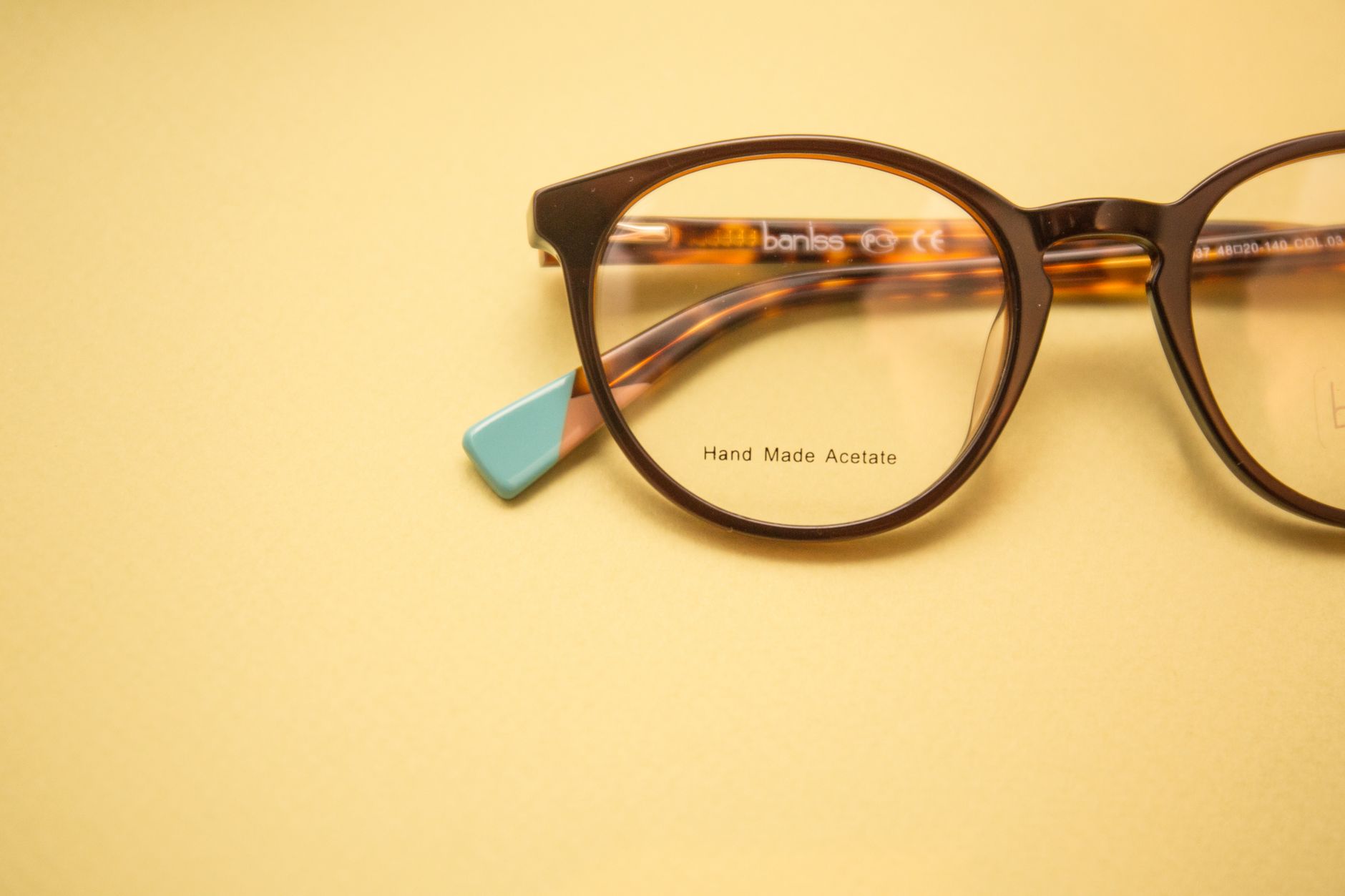
The frame front and each temple are usually finished separately before assembly, since polishing is much easier to control on a flat piece than on a hinged, three-dimensional one.
How are metal frames made differently?
Metal frames are built rather than carved — pieces are cut, bent, soldered or welded, then finished, rather than milled down from a solid block.
Wire and tube are cut to length, bent around forms to get the bridge and eyewire curves, and joined at the seams. Titanium is harder to work with than steel and needs specific welding conditions, which is part of why it costs more to produce — see what titanium buys a frame beyond the price tag. Monel, a nickel-copper alloy, has been a mainstay of metal eyewear for decades precisely because it’s easy to solder and shape, which is why it’s worth understanding what monel is and why it’s still so common in mid-range and premium frames alike.
Plating and colour coating happen near the end, after the metal parts are formed and polished but before final assembly — a plated finish that’s applied over rough metal will never look right, no matter how good the plating itself is.
Where do hinges come in?
Hinges are fitted after the front and temples are otherwise finished, and the type chosen affects both how the frame feels day to day and how easily it can be repaired later.
A barrel hinge with a screw is the standard, visible approach. Some makers instead use a screwless hinge, which relies on a pin or friction fit rather than a screw that can work loose. Others build in a spring hinge, which lets the temple flex outward under load — genuinely useful for comfort, but with its own specific failure points worth knowing before buying. Older and some current handmade frames still use a rivet hinge, a much older technique some makers keep for its solidity rather than its speed.
None of these choices is inherently “better” — they trade off differently between smoothness, repairability and how the frame will behave years in.
How are the lenses fitted into the finished frame?
Once the frame itself is complete, the lens openings are cut to match the specific lenses going into that pair, and the lenses are edged and inserted, either by the maker or later by the optician glazing a prescription order.
This is a separate discipline from frame-making, governed by its own set of terms — how the lens curve relates to the frame front, how far the lenses sit from the eye, and how they’re ground down to fit the shape of the rim. None of that is something a shopper needs to master, but it’s worth knowing it’s a distinct stage of the process, covered in more depth across the site’s lenses and coatings coverage.
What separates a well-made frame from a cheap one?
Mostly, it comes down to how much finishing work happened before assembly, and how consistent the frame is from piece to piece.
- Edges that are genuinely smooth to the touch, not just shiny — run a finger along the inside of the rim.
- Hinges that sit flush and move without play, rather than wobbling side to side.
- Consistent colour and thickness across both temples and both sides of the front, especially on laminated acetate.
- Weight that’s been considered, not just accepted — a frame that hasn’t been thinned or balanced properly is part of why heavy frames feel worse by the end of the day.
None of this shows up in a product photo. It shows up when the frame is on a face, which is really the only test that matters — a point covered in more detail in what actually makes a frame comfortable over eight hours of wear, and worth reading before judging a frame on looks alone.
Understanding the process doesn’t make one material objectively superior to another — it just gives a shopper a better sense of what they’re actually paying for, and where in the process a maker chose to cut a corner. For a broader sense of how different shapes and eras of design get built this way, the frames and styles archive is a useful place to keep looking.
The Designer Glasses publishes general information and style opinion, not professional advice. We are writers and enthusiasts, not opticians, optometrists or dispensing opticians. Nothing here interprets a prescription, recommends a lens power, or tells you whether you need correction — only an eye examination can do that. If your vision changes suddenly, or you have eye pain, flashes, new floaters or halos around lights, treat it as urgent and contact an eye care professional the same day. Sunglasses should carry a stated UV rating: a dark lens without UV filtering is worse than none at all.