A laminated acetate frame is made by fusing two or more sheets of acetate together — often different colours, patterns or finishes — before the frame shape is cut from the block. The result is a single piece of material with visible depth: one colour showing through another, or a solid tone backed by something translucent.
It’s not a coating and it’s not a print. The layers are physically bonded under heat and pressure, then sanded and polished as one solid piece, which is why the effect holds up over years of wear rather than wearing off.
How is a laminated acetate frame actually made?
Sheets of acetate are stacked in a chosen order, then heated and pressed together into a single block, which is later cut, shaped and polished into the frame front and temples.
Standard acetate frames are cut from a single sheet of one colour or pattern. Lamination changes that starting point. A manufacturer might press a translucent amber sheet over a solid tortoiseshell, or sandwich a thin coloured layer between two clear ones, so that when the frame is bevelled at the edge, the layers become visible as a rim of colour around the lens opening or along the temple.
Because the block is solid rather than surface-treated, the layered effect is consistent whether you’re looking at the front, the temple, or the cut edge near the hinge. Nothing is printed on top of the acetate — it’s built into it. This is the same broad family of material discussed in our piece on what acetate is and why good frames use it, but lamination is a specific technique within that material, not a different substance.
What does lamination actually look like on a finished frame?
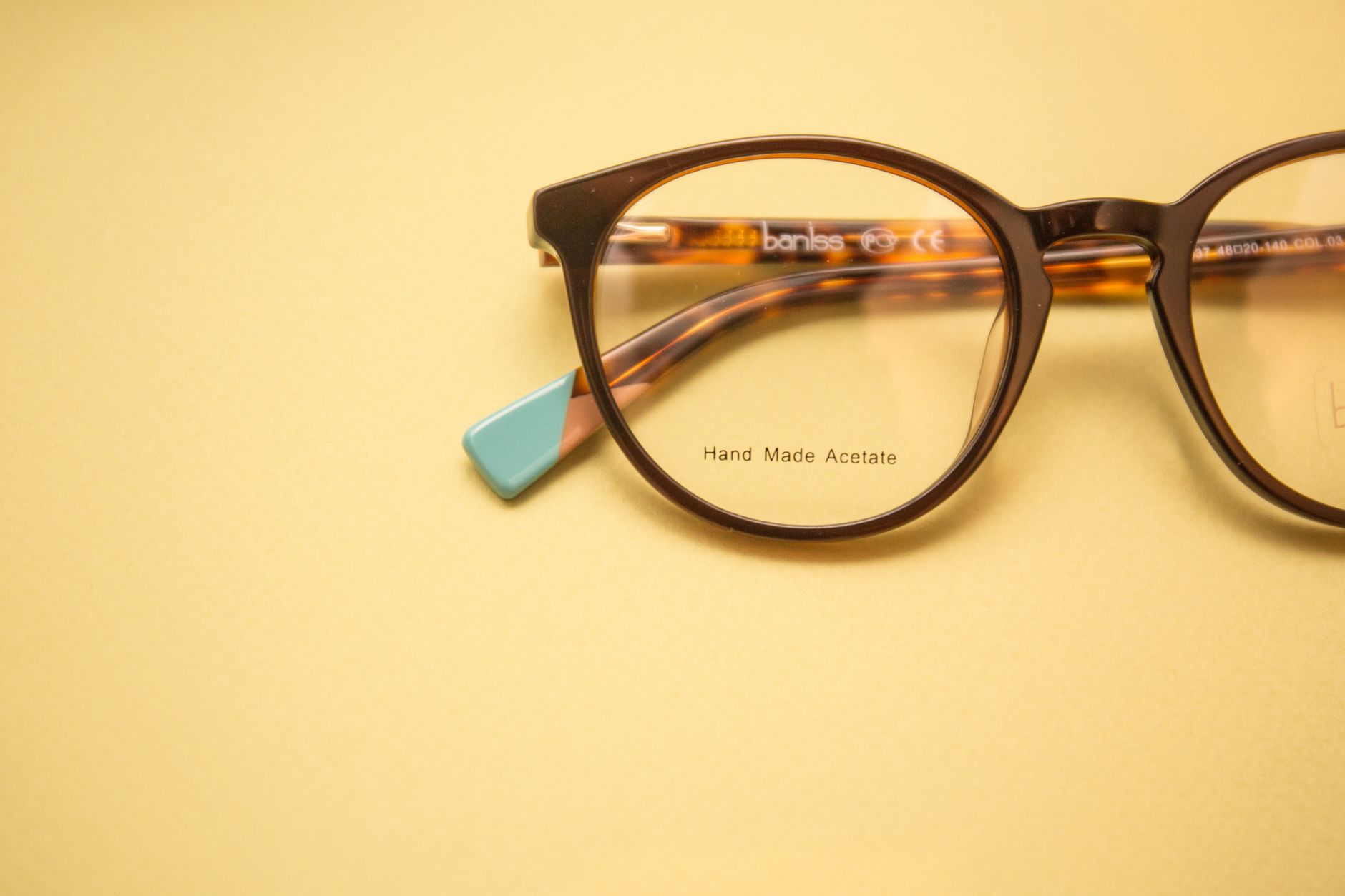
Laminated frames typically show a visible colour change at the bevelled edge — a thin band of a second tone around the lens rim, or a gradient that shifts from opaque at the top of the frame to translucent lower down.
Common effects include:
- A dark front colour with a lighter or clear layer showing only at the cut edge
- Two contrasting solid colours, so the frame reads as one shade head-on and another from the side
- A patterned layer — tortoiseshell, marbled, fleck — backed by a plain colour that shows through at the edges
The edge detail is often the giveaway that a frame is laminated rather than solid acetate. If you run a finger along the bevel and see a distinct line of colour that isn’t present on the flat surfaces, that’s a lamination seam, not a trick of the light.
Why does a laminated frame cost more than a solid acetate one?
Laminated acetate costs more because it requires extra material, extra pressing time, and more careful cutting to keep the layers aligned and centred across a symmetrical pair of frames.
A single-colour acetate block starts as one sheet. A laminated block starts as several sheets of different colours, each cut and stacked before pressing, and the alignment has to be precise enough that the left and right frame fronts — and the two temples — show the layering in the same place. Waste is higher too, since more material is trimmed away in the shaping process to reveal the layered edge cleanly.
None of this is a comment on how a frame will perform on your face, and higher production cost is not the same as a claim about durability or comfort. What it buys is a visual effect that a single-sheet frame can’t produce. For a broader look at how manufacturing choices affect what a frame is actually worth, our piece on what makes a frame look expensive covers the visual cues that tend to separate considered construction from a quick cut.
Is laminated acetate the same as injection-moulded plastic frames with a colour effect?
No. Laminated acetate is cut from a solid, layered block of cellulose acetate, while injection-moulded frames are formed by pouring molten plastic into a mould. The two processes produce very different edges, weights and finishes, even when the colours look similar in a photograph.
Injection moulding can mimic a two-tone look by using different plastics in a single mould, but the transition tends to be sharper and more uniform, without the slight organic variation that a hand-finished acetate edge has. If you want the fuller comparison of how these materials are made and what that means for how a frame wears, it’s laid out in acetate vs injection-moulded plastic: the real difference.
Does lamination affect how a frame fits or feels?
Not meaningfully. Lamination is about colour and pattern, not structure — a laminated frame is shaped, polished and fitted the same way any acetate frame is, and its comfort depends on the same things: temple length, hinge quality, and how well the bridge sits on your nose.
Weight can shift slightly depending on how many layers are used and how thick the final block is, but this is a minor factor next to overall frame size and temple design. If comfort over a full day is the priority, the more useful reading is what makes a frame comfortable over eight hours, which covers the fit factors that apply regardless of colour or finish.
Can a laminated acetate frame be repaired or adjusted the same way?
Generally yes — laminated acetate can be heat-adjusted and repaired much like standard acetate, since it’s still one solid piece of material once pressed and cut. The layering doesn’t come apart under normal adjustment or gentle heat.
What it can’t survive is the same thing that damages any acetate frame: deep scratches or a badly judged repair can cut through one layer into another, exposing a colour that was meant to stay hidden beneath the surface. That’s a cosmetic risk specific to laminated pieces, worth mentioning to whoever adjusts the frame. For a general sense of what’s fixable and what isn’t across frame materials, see can glasses be adjusted, and what can’t be fixed.
Why bother with lamination at all?
Because colour with depth reads differently on the face than flat colour. A laminated frame can look tortoiseshell from across a room and reveal a warm amber or grey undertone up close, which is a more interesting proposition than a single, unchanging tone — and it’s the reason these frames tend to sit at the more considered end of a collection rather than the entry point.
This is a matter of taste, not performance, and it’s worth treating it that way. A bold laminated colourway can carry a frame that would otherwise be too plain, or it can compete with strong features and end up busier than intended — the same judgement call covered in when does a bold frame stop working. Whether the layered effect suits a particular shape and colouring is worth working through against the frame itself rather than assuming complexity always reads as quality; our wider notes on how frame colour changes how glasses read and the general materials and craft archive are useful starting points if you’re comparing several options before deciding.
What should you look for when comparing laminated frames in person?
Look at the bevelled edge under good light, check that the layering is symmetrical across both sides of the frame, and confirm the colour transition is deliberate rather than an accident of a poorly cut block.
- Hold the frame up to a window — translucent layers should show real depth, not a flat, muddy tone
- Compare left and right fronts and temples for matching layer placement
- Check the polish at the bevel is smooth, with no visible tool marks between layers
- Ask what the base layers are made of if the listing doesn’t say — reputable makers will know
None of this replaces the fit fundamentals. A beautifully laminated frame that’s too wide, sits unevenly on the nose, or has temples that are the wrong length will still be a frame you don’t reach for. It’s worth reading the general frames and styles archive alongside any material research, so the decision is made on shape and construction together rather than colour alone.
The Designer Glasses publishes general information and style opinion, not professional advice. We are writers and enthusiasts, not opticians, optometrists or dispensing opticians. Nothing here interprets a prescription, recommends a lens power, or tells you whether you need correction — only an eye examination can do that. If your vision changes suddenly, or you have eye pain, flashes, new floaters or halos around lights, treat it as urgent and contact an eye care professional the same day. Sunglasses should carry a stated UV rating: a dark lens without UV filtering is worse than none at all.