Glasses slip in hot weather because skin gets oilier and sweatier, which reduces the friction that normally holds nose pads and temple tips in place, and because some frame materials soften very slightly at skin temperature. The fix is rarely the frame itself — it’s usually the nose pad contact, temple length, or weight distribution not being right for the face underneath.
Why do glasses slip more when it’s hot?
Sweat is the obvious culprit, but it’s only half the story. Skin also produces more oil in heat, and oil is worse than water for grip — it acts as a lubricant rather than washing away. At the same time, acetate and some plastics become marginally more pliable as they warm, which can loosen a fit that felt snug in cooler weather. None of this means the glasses are wrong for the face; it means the margin for error has shrunk.
Is it the frame or the fit?
Before blaming a design, it’s worth separating two different problems. One is a frame that never fit well and has been getting away with it in cool, dry conditions. The other is a frame that fits fine most of the year but has no reserve capacity for heat. Constant sliding, in any weather, usually points to the first problem — a pantoscopic angle, bridge width, or temple length that was never quite matched to the face. Slipping that only shows up on hot days is closer to the second, and it’s a much smaller fix.
Do nose pads help?
Nose pads are the first thing to check, and the most commonly mis-set part of any frame. Adjustable pads on a metal frame can be angled to increase the contact area against the sides of the nose rather than resting on a single point, which spreads the load and improves grip without needing to be pinched painfully tight. Acetate frames with a fixed keyhole or saddle bridge don’t have this adjustability — the bridge shape is cut into the material itself — which is one reason some acetate frames feel less secure the moment skin gets warm.
Silicone pad sleeves, where fitted, also grip better than bare metal or acetate against damp skin, and they’re a small, inexpensive thing an optician can usually swap.
What do temple length and tip style change?
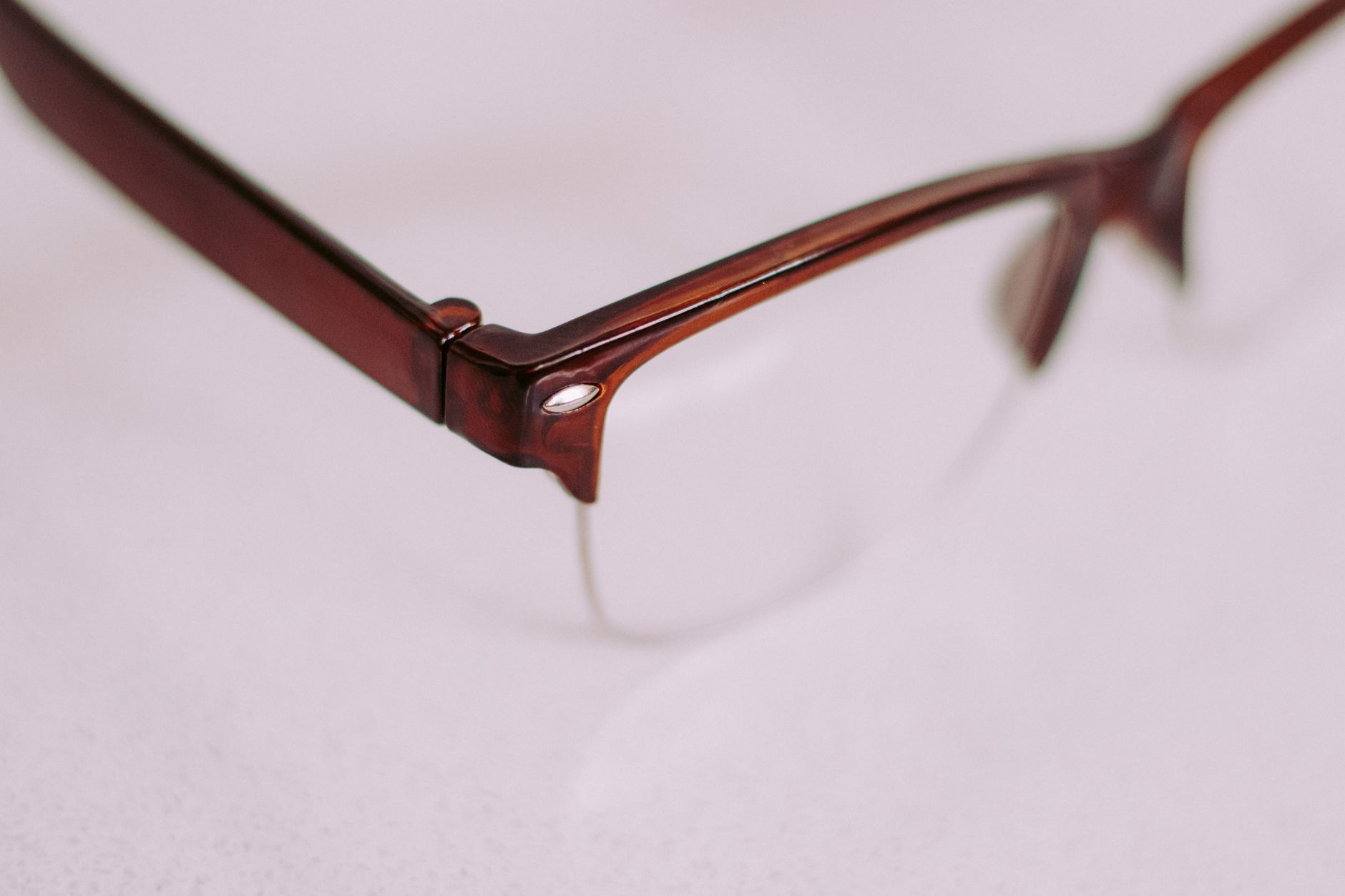
A huge amount of slipping comes down to temple length being slightly too long or the wrong curve behind the ear. If the temple doesn’t hook down and back with a bit of tension at the point it clears the ear, the whole frame has nothing stopping it from creeping forward as the nose pads lose their grip. Temple tips matter too — a hard acetate tip slides on sweaty skin far more readily than a softer, slightly textured tip, and some frames can be fitted with the latter without changing anything else about how they look.
Does frame weight matter in heat?
Yes, disproportionately. A frame that feels perfectly fine at a normal, dry weight starts to matter the moment the pads it’s resting on lose traction. Heavier frames rely more on the nose pads and less on friction along the temple, so as grip drops in heat, a heavy frame has further to fall before something stops it. This isn’t an argument for buying the lightest frame available — plenty of heavier metals and acetates are worth the trade-off in look and durability — but it’s worth knowing that a frame’s weight-to-grip balance changes with the weather, not just with the material on paper.
Can adjustments fix it, or is it the material?
Most slipping that appears suddenly in summer is an adjustment problem, not a design flaw, and it’s usually solved in minutes by someone qualified to do it. A professional adjustment can re-angle pads, tighten hinge tension, or reshape the curve behind the ear — all of which restore the margin that heat has eaten into. It’s worth resisting the urge to bend a frame at home; metal fatigues with repeated flexing and acetate can crack if forced cold, so a small in-store adjustment is the better route.
Material choice does play a longer-term role. Frames in certain metals and treated acetates hold their set shape better across temperature swings than softer plastics, which is one reason the same style can feel secure in one material and looser in another after a season of wear.
What about sunglasses specifically in hot weather?
Sunglasses face the same slipping problem, compounded by being worn outdoors in direct heat and often during activity. Sunglasses generally need a snugger, closer-wrapped fit than everyday prescription glasses, partly to block peripheral light and partly because they’re doing their job in exactly the conditions — sun, sweat, movement — that cause slipping in the first place.
It’s worth repeating, since it comes up constantly around summer eyewear: a darker lens is not the same as a protective one. A dark tint with no stated UV rating can actually let more ultraviolet light reach the eye than no sunglasses at all, because the tint causes the pupil to open wider while doing nothing to filter the UV coming in. Genuine protection comes from a labelled UV400 or 100% UVA/UVB filter, not from how dark or expensive the lens looks.
When is slipping actually a sign of poor fit, not the weather?
If glasses only slide in heat and sit perfectly the rest of the year, that’s a seasonal fit issue worth solving with adjustment rather than a new frame. But if they’ve always needed pushing back up, regardless of temperature, that’s a different conversation — about bridge width, pad placement, or a frame that was slightly wrong for the face from the start. How glasses are meant to sit on the nose and ears is a useful baseline to check against before assuming the weather is the whole story, and it’s worth mentioning any persistent discomfort, pinching, or marks to an optician rather than living with it through summer.
The Designer Glasses publishes general information and style opinion, not professional advice. We are writers and enthusiasts, not opticians, optometrists or dispensing opticians. Nothing here interprets a prescription, recommends a lens power, or tells you whether you need correction — only an eye examination can do that. If your vision changes suddenly, or you have eye pain, flashes, new floaters or halos around lights, treat it as urgent and contact an eye care professional the same day. Sunglasses should carry a stated UV rating: a dark lens without UV filtering is worse than none at all.