Tiny sunglasses came back because fashion moves in proportion cycles, and after two decades of oversized lenses, the eye got tired of big shapes and started reading small ones as fresh again. The micro frame also flatters a face on camera in a way that huge lenses don’t, which matters more now than it used to.
Why Did Tiny Sunglasses Come Back?
Trend cycles in eyewear tend to run in reverse against whatever came before. Oversized lenses dominated for so long — square, round, cat-eye, all inflated in scale — that a small rectangular or oval lens now reads as deliberate rather than dated. The tiny frame also photographs differently: on a phone screen, a huge lens can flatten a face, while a small one leaves the features doing the work. That’s a large part of why the shift happened when it did, alongside a broader style move back toward slim, minimal accessories generally.
There’s also a simple pendulum effect at work in frame history. The same swing has happened before with other shapes and other decades, which is worth reading about if the pattern itself interests you — see how 1950s frame shapes keep resurfacing on a similar rhythm, and how the 1970s oversized frame set the scale that tiny sunglasses are now reacting against.
Where Did Tiny Sunglasses Actually Come From?
The small rectangular lens has direct roots in late-1990s and early-2000s eyewear, and further back, in the narrow oval and rimless shapes worn through parts of the mid-20th century. It isn’t a new invention — it’s a revival of a specific scale that fell out of fashion once bigger lenses took over.
What’s changed on the return trip is materials and finishing. A tiny metal frame today is more likely to use fine, well-finished hardware — thin wire fronts, delicate hinges, careful plating — because at that scale, any roughness in the build is immediately visible. There’s nowhere for a badly finished joint to hide on a lens that small.
Is Tiny Sunglasses a Face-Shape Rule-Breaker?
The conventional styling advice says small frames suit narrower or more angular faces, since a tiny lens can look pinched on a wider one. That’s a starting point, not a rule — plenty of people with fuller faces wear a small frame deliberately, using the contrast rather than trying to match proportions.
Face-shape guidance is opinion dressed up as science more often than not. It’s worth treating it as a rough steer and nothing firmer — whether face-shape rules for glasses actually hold up is a longer conversation, and the honest answer is that they’re conventions worth knowing and just as worth ignoring. The more reliable test is simply trying a frame on and looking at where the lens edge sits relative to the brow and cheekbone, rather than working from a chart.
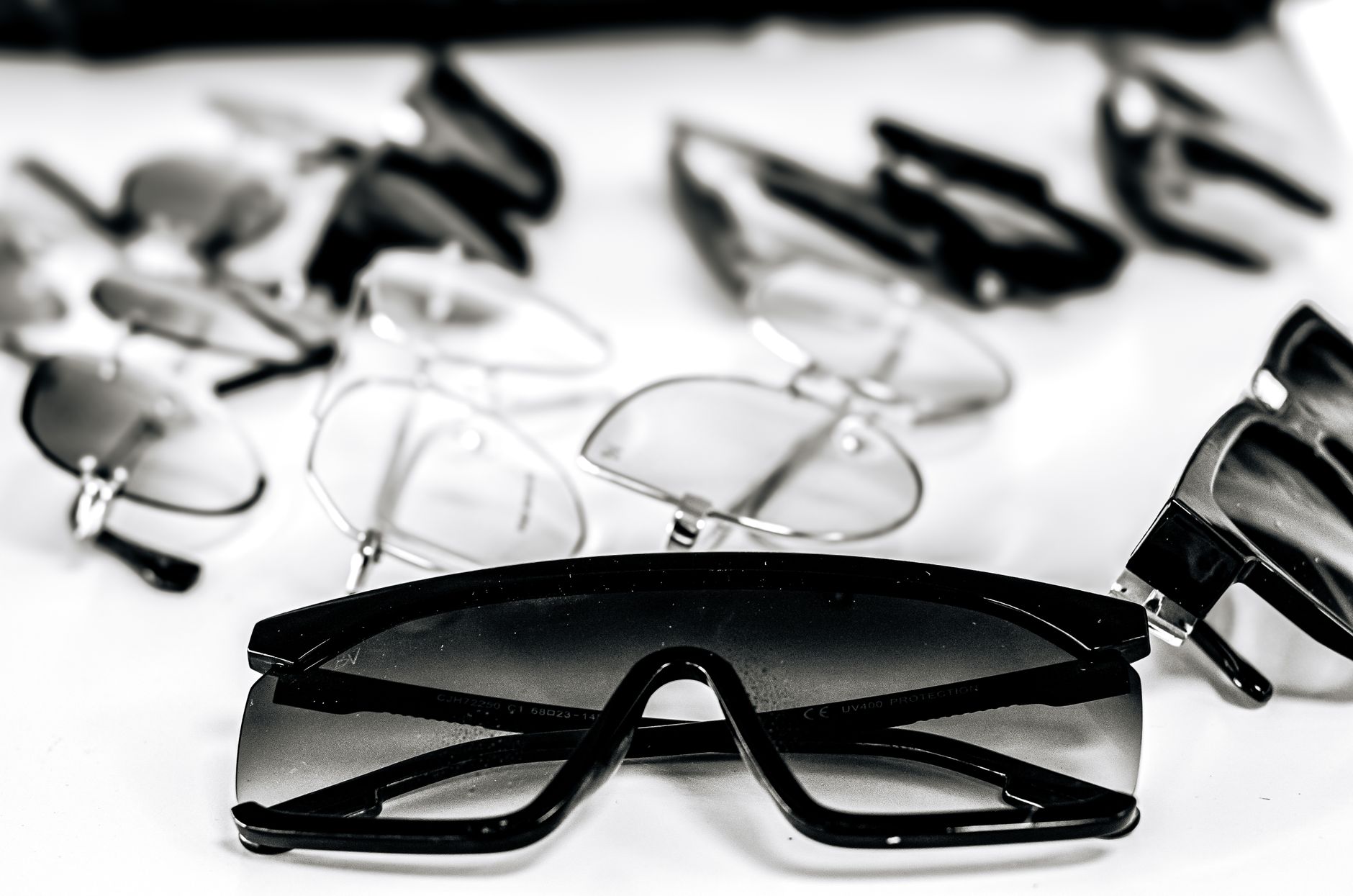
Do Small Frames Protect Your Eyes as Well as Large Ones?
A smaller lens covers less of the eye area and the surrounding skin, so more light — including UV — can reach the eye from above, below and the sides compared with a larger or wraparound shape. That’s a genuine trade-off of the silhouette, separate from the lens itself.
What the lens is actually doing matters more than how big it is. A dark tiny lens with no stated UV filter offers less protection than a paler lens carrying a UV400 or 100% UVA/UVB rating — darkness alone doesn’t block anything, and a dark lens without a UV rating is worse than wearing no sunglasses at all, because the tint makes the pupil open wider and let more UV in. Look for the rating, not the shade, and treat colour and size as separate questions from protection entirely. For anyone wanting the fuller picture, how to tell if sunglasses are genuinely UV protective covers what to actually check on a label.
If coverage is a real concern — long days outdoors, driving, glare off water or snow — a small frame is not the shape built for that job. That’s what larger and wraparound styles are for; see what a wrap frame is actually built to do for the contrast.
What Should You Compare Before Buying a Small Frame?
Scale is the whole point of a tiny frame, so getting the proportion right matters more than with a mid-size shape. A few things are worth comparing side by side rather than judging from a photo:
- Lens height and width relative to the brow and cheekbone — a lens that sits too high can look like it’s floating on the face.
- Bridge width and fit — small frames often have a narrower bridge, and a fraction of a millimetre off changes how the whole shape sits.
- Temple length and how the arm sits over the ear, since a tiny front doesn’t leave much margin for a temple that’s slightly wrong.
- Hinge quality — at this scale, a loose or scratchy hinge is more noticeable, not less.
- Lens category and tint darkness, which is a separate decision from the UV rating and worth checking against what the sunglass lens category numbers 0 to 4 actually mean.
None of this is about picking a “best” model — it’s about knowing what to look at on any pair in front of you. The guide to choosing frames and sunglasses goes through the same comparison points in more depth, and the sunglasses archive covers lens and shape questions specific to sun wear.
Are Tiny Sunglasses Just a Trend, or Are They Here to Stay?
Tiny sunglasses will almost certainly swing back toward larger scale again at some point, the way every proportion in eyewear eventually does. That doesn’t make the shape a poor buy now — it makes it a style choice with a shelf life, which is true of most fashion-forward frames rather than a flaw specific to this one.
The frames that outlast the swing tend to be the ones bought for fit and build quality rather than for the trend alone — a well-made small frame in a classic material still works once the moment has passed, worn with a bit less self-consciousness about the size. For a broader sense of how eyewear trends rise and fade, the trends and icons archive tracks the pattern across decades, and the frames and styles archive is the place to look at shape and proportion questions on their own terms.
The Designer Glasses publishes general information and style opinion, not professional advice. We are writers and enthusiasts, not opticians, optometrists or dispensing opticians. Nothing here interprets a prescription, recommends a lens power, or tells you whether you need correction — only an eye examination can do that. If your vision changes suddenly, or you have eye pain, flashes, new floaters or halos around lights, treat it as urgent and contact an eye care professional the same day. Sunglasses should carry a stated UV rating: a dark lens without UV filtering is worse than none at all.
Related reading
How Eyewear Works, What Is Quiet Luxury in Eyewear? A Style Explainer.