Glasses should be stored folded, lenses facing up, inside a rigid case, somewhere that stays at roughly room temperature and out of direct sun. The three enemies are pressure on the lenses, heat that can warp frame material or soften adhesives, and the kind of loose storage — bags, pockets, tabletops — that invites scratches and bent hinges.
How should glasses be stored day to day?
The habit that matters most is also the simplest: fold the temples in, set the frame down lens-side up, and put it in a hard case rather than leaving it on a surface. A hard case absorbs impact that a soft pouch or bare table cannot. Lenses-up matters because it keeps the lens surface off whatever the frame is resting on — grit on a nightstand, dust on a desk, crumbs on a kitchen counter all become scratches waiting to happen the moment a lens is set down face-first.
This is one of those pieces of advice that sounds almost too obvious to write down, and yet the single most common source of preventable damage to a pair of glasses is not a dramatic accident. It is a frame set down carelessly a few thousand times over its life. Small, repeated carelessness is what actually wears glasses out.
Why does a hard case matter more than a soft pouch?
A hard case matters because it’s the only storage method that protects glasses from a direct sit-on, step-on or drop when they aren’t being worn. Soft pouches protect lenses from surface scratching but do nothing against crushing force.
A microfibre pouch is genuinely useful for keeping dust and light smudging off lenses in transit, and it’s a reasonable place to slip glasses for a few minutes on a desk. But it offers no structural protection. Sat on, stepped on, or squashed at the bottom of a bag, a pouch will not stop a frame from bending or a lens from cracking. A hard case — the kind with a rigid shell and some padding inside — is the only format that actually resists an impact. This is doubly true for anything made from acetate or a lightweight titanium, where the difference between a case that flexes and one that doesn’t can be the difference between a frame that lasts years and one that needs adjusting every few months. For more on what the frame itself is made of and how that affects durability, the materials and craft archive is worth a browse.
Where in the house is the worst place to leave glasses?
The worst spots are anywhere hot, anywhere damp, and any flat surface glasses might be sat or knocked off. That means windowsills, car dashboards, bathroom shelves near steam, and the arm of a sofa are all poor choices, even for a few minutes.
Heat is the quiet one. Acetate frames, and the adhesives used in some hinge and temple constructions, can soften or distort at temperatures well below what feels dangerous to a person. A windowsill in direct sun, or a car interior on a warm day, can get hot enough to warp a frame’s shape permanently — often without the owner noticing until the fit has changed. This connects directly to a subject worth reading in full: why some glasses frames yellow or go brittle with age, since heat and UV exposure over time are part of that story.
Bathrooms bring a different problem — humidity, which over years can affect metal plating and some coatings. It’s not usually dramatic, but a bathroom shelf is not a neutral place to rest a pair of glasses night after night.
Should sunglasses be stored differently from prescription glasses?
Not fundamentally — the same rules of a rigid case, lenses up, away from heat apply. The one extra consideration is that sunglasses spend more time in cars, bags and pockets during travel, so a case that’s genuinely rigid (rather than a soft slip case) earns its keep more often.
Sunglasses are also more likely to have tinted or mirrored coatings, both of which can show scuffing more visibly than a clear lens, since any scratch reflects light differently against a dark or mirrored background. It’s worth remembering, while on the subject of sunglasses, that a dark tint is not what protects the eyes — UV protection comes from a stated UV400 or 100% UVA/UVB filter, not from how dark or expensive the lens looks. That’s a separate issue from storage, but it’s worth having front of mind whenever sunglasses come up. The sunglasses archive covers this in more depth.
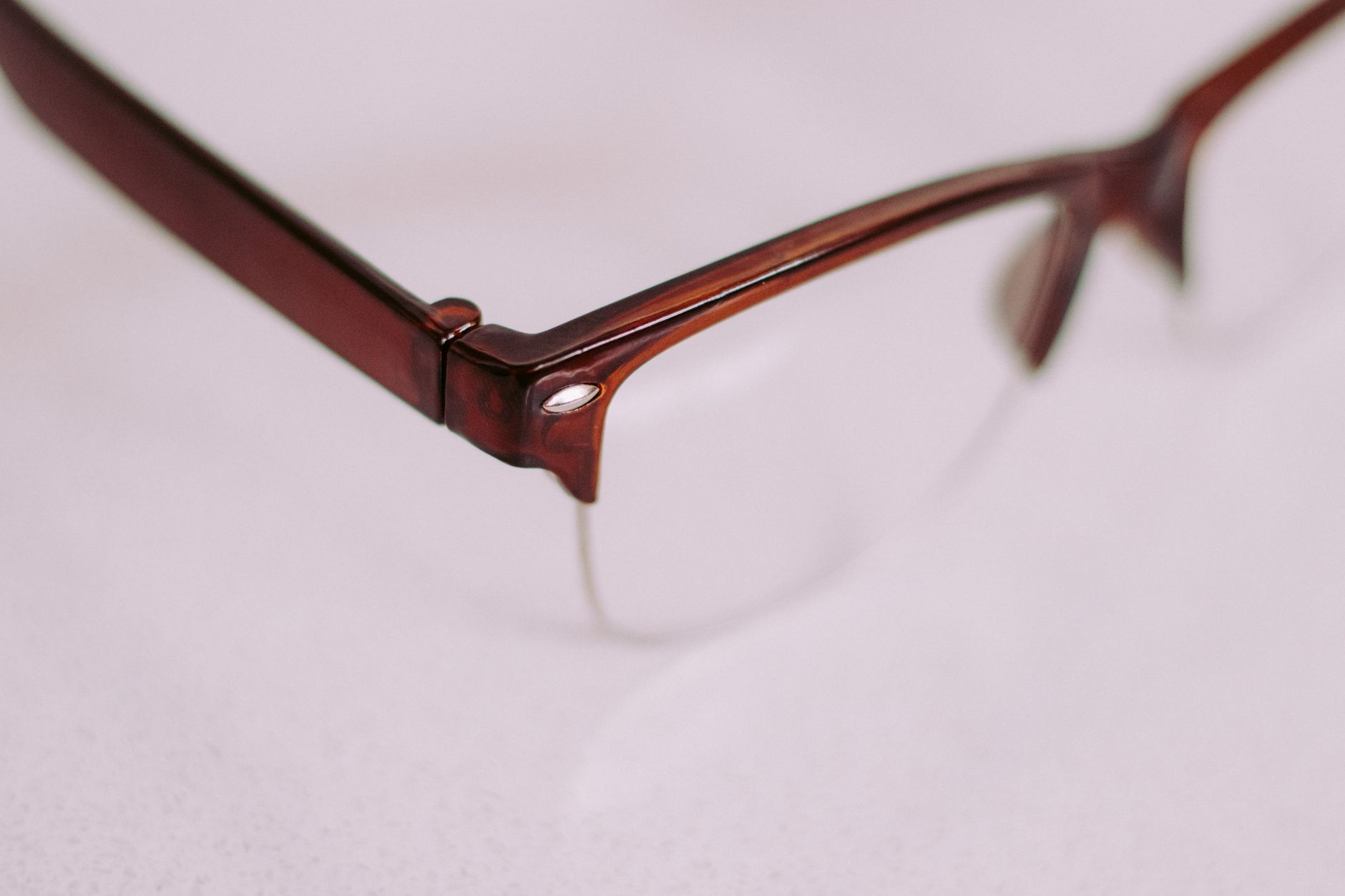
What actually happens to a frame left in a hot car?
A frame left in a hot car can warp, especially at the temples and around the nose bridge, and any adhesive-set elements can loosen. This is one of the more common causes of a frame that suddenly sits crookedly for no obvious reason.
Car interiors on a sunny day can reach temperatures far higher than the air outside, and a glovebox or dashboard concentrates that heat further. Acetate is particularly sensitive to this, since it’s a thermoplastic that can be reshaped with heat during manufacture — the same property that makes it easy to hand-finish also makes it vulnerable to distortion in storage. Metal frames fare better structurally but plated finishes can still be affected over repeated heat cycles; there’s more on how plating behaves and wears in what plating on glasses actually is, and why it wears through. If a frame does come out of a hot car looking or sitting differently, it’s worth having it checked rather than assuming it will settle back — some distortion can be adjusted, some can’t, and what can and can’t be fixed is a useful primer before deciding.
Does how glasses are folded matter?
Yes — folding one temple at a time, in the order the frame is designed for, avoids putting sideways stress on the hinge. Folding both temples in at once, or forcing a frame that resists folding, is a common way hinges loosen prematurely.
Most frames are built so one temple folds slightly before the other, nesting the pair together. Ignoring this and closing both temples simultaneously puts uneven pressure through the hinge barrels, which over time contributes to looseness or a hinge that no longer holds its angle. This matters more with some hinge types than others — a spring hinge fails in a different way to a rigid one, and understanding what’s inside the temple helps explain why gentle, consistent folding actually extends a frame’s working life rather than being a fussy habit.
Does storage affect lens coatings?
Anti-reflective and scratch-resistant coatings are affected less by storage itself and more by what glasses touch while stored — grit in a pocket, a bag’s inner lining, or being set lens-down on a hard surface. Good case habits protect coatings indirectly by preventing that contact.
Coatings don’t typically degrade just from sitting in a case. What damages them is abrasive contact: a lens resting against keys or coins in a jacket pocket, or being wiped with whatever cloth happens to be nearby rather than a proper lens cloth. It’s worth reading why cleaning glasses with a shirt causes damage alongside this, since the two habits — bad storage and bad cleaning — tend to travel together and compound each other. If a coating has already started to show fine cracking or a hazy smudge that won’t lift, why coatings craze and whether it can be fixed and what actually removes smudges from an anti-reflective coating both cover what’s fixable and what isn’t.
How should multiple pairs be stored together?
Each pair deserves its own case rather than being stacked or piled together. Frames touching frames — metal against acetate, or hinge against lens — is one of the more avoidable sources of scuffing and misalignment in a household with more than one pair in rotation.
Anyone who owns several pairs, perhaps a daily frame and a separate pair for sun, benefits from treating each one as an individual object rather than a drawer of interchangeable spectacles. A stack of glasses in a drawer will eventually scratch, snag, or bend against each other, usually in ways that aren’t noticed until the damage is done. Separate cases, kept somewhere stable and dry, cost very little in space and prevent almost all of it. More on how frame choices and fit interact day to day can be found in the frames and styles archive and the care and comfort archive, both useful reading for anyone building out a small collection rather than relying on a single pair.
Is any of this urgent?
Storage habits are about longevity and appearance, not eye health emergencies. That said, if a change in vision, eye pain, new floaters, flashes of light, or sudden vision loss in one eye ever comes up — regardless of what’s happening to the glasses themselves — that is a same-day matter for an eye care professional, not something to wait out.
The Designer Glasses publishes general information and style opinion, not professional advice. We are writers and enthusiasts, not opticians, optometrists or dispensing opticians. Nothing here interprets a prescription, recommends a lens power, or tells you whether you need correction — only an eye examination can do that. If your vision changes suddenly, or you have eye pain, flashes, new floaters or halos around lights, treat it as urgent and contact an eye care professional the same day. Sunglasses should carry a stated UV rating: a dark lens without UV filtering is worse than none at all.