A frame stays comfortable over eight hours when its weight is spread across three points — the nose, and both sides of the head — instead of concentrated on one. Comfort is a function of weight, balance, temple length and how well the frame matches the width and contours of a specific face. Everything else is secondary to that fit.
Why do glasses feel fine in the morning but not by evening?
Nothing changes in the frame between 9am and 5pm — what changes is skin. Sustained, low-grade pressure on the same two spots behind the ears and across the nose eventually registers as discomfort, even if the pressure itself was never painful. This is cumulative, not sudden, which is why a frame can feel entirely unremarkable in a shop mirror and still leave a mark by the end of a working day.
Weight is the multiplier. A heavier front adds torque that the temples and nose have to resist all day, and that effort shows up as tension at the temples first. The mechanics of this are covered in more detail in why heavy frames feel worse by the end of the day, but the short version is: it is rarely the total weight of the frame that matters most, it is where that weight sits relative to the hinge.
What are the actual contact points that decide comfort?
Three points carry a frame: the bridge of the nose, and the two areas just above and behind the ears where the temples rest. Comfort over a long day depends on all three sharing the load evenly, rather than one point taking most of it.
- Nose pads or bridge shape — set the front’s height and angle, and take a share of the weight.
- Temple length — determines whether the arm ends at a stable point behind the ear or stops short and digs in.
- Temple tip curve and material — decide whether that end point grips gently or presses.
If any one of these is slightly wrong, the other two end up compensating, and compensation is what turns into a red mark or a headache by mid-afternoon. How glasses should sit on the nose and ears goes into what “correctly fitted” actually looks like at each of these points.
Why do nose pads matter so much for long wear?
Nose pads control both the height of the lenses and how concentrated the frame’s weight is on a small area of skin. Adjustable pads let that pressure be spread and repositioned; fixed pads on a plastic bridge cannot be altered at all.
This is one of the few genuinely mechanical differences between frame types, not a styling choice. A frame with adjustable metal pads can usually be fine-tuned by an optician to sit slightly higher, lower, or wider, which matters more for a nose that doesn’t match the “average” bridge a frame was designed around. What nose pads are for, and when adjustable ones matter covers this in more depth, and why glasses leave marks on the nose explains what to do about the marks specifically.
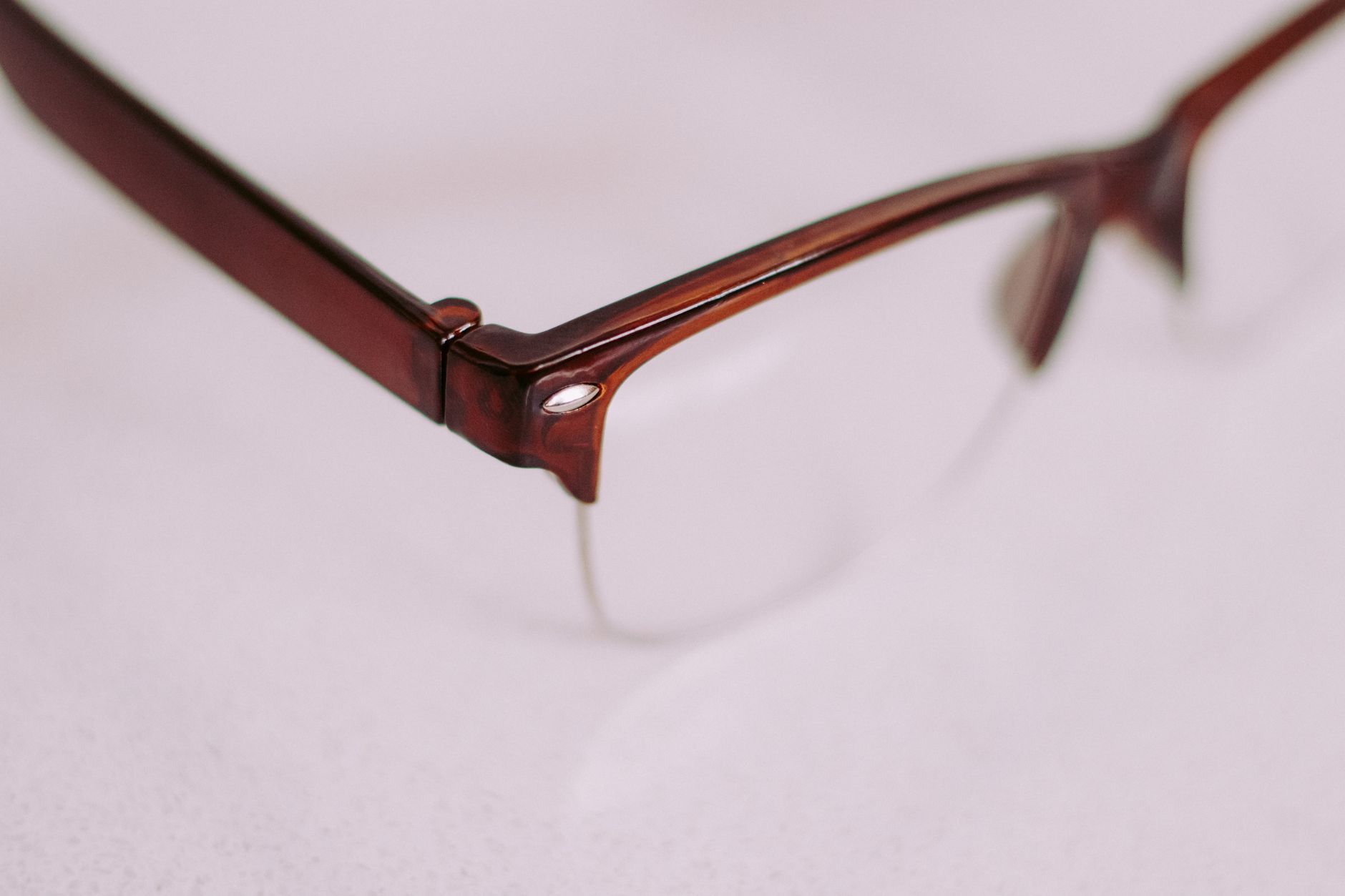
Does temple length actually change how a frame feels?
Yes — more than most people expect. A temple that’s too short ends before it reaches a stable point behind the ear, so it has to grip harder further forward to stay put, which is a common and underrated cause of pinching and headache by the end of a day.
Temple length isn’t a single universal size; it’s specified per frame and can often be swapped or adjusted within limits. What temple length is, and why it matters more than you think explains how to check whether a temple is the right length for a given head, and what causes glasses to pinch behind the ears covers the specific failure mode when it isn’t.
Does frame material change comfort across a full day?
Material affects weight, flexibility and how a frame ages against skin — three things that compound over eight hours. A lightweight, slightly flexible frame that returns to shape after being taken off and put back on repeatedly will generally feel more consistent by hour six than a heavier, rigid one that slowly loses its adjustment.
This isn’t the same as saying one material is objectively best — acetate, metal and various plastics all have different trade-offs in weight, warmth against skin and how well they hold an adjustment. The comparisons worth understanding are laid out across Materials & Craft, and are worth reading before assuming the most expensive-looking option is automatically the most comfortable one.
Does frame width matter as much as weight?
Width matters because a frame that’s too narrow for the face pulls in at the temples constantly, and one that’s too wide has nothing to grip and slides. Both problems get worse, not better, as the day goes on.
Getting the width right is a proportion question as much as a comfort one — a frame sized correctly for the face usually looks better too, since it isn’t straining at the temples or overhanging the outer edge of the brow. How wide a frame should be relative to face width sets out how to judge this by eye. For anyone whose bridge and temple proportions sit outside a “standard” fit, standard vs Asian-fit frames explains a real, mechanical difference in how these frames are built, not just labelled.
Can a frame that hurts be fixed, or is it the wrong frame?
Often it can be fixed. Temple arms can be bent for a better curve behind the ear, nose pads can be repositioned, and the overall angle of the front can be adjusted so weight sits more evenly. What can’t usually be fixed is a frame that’s fundamentally the wrong width or the wrong temple length for a given head — bending only stretches so far.
Before writing off a frame as simply “uncomfortable”, it’s worth having it properly adjusted once, since a five-minute change at the temple or bridge often resolves what felt like a design fault. What can be adjusted, and what can’t be fixed is a useful gut check before buying a replacement.
Does the lens itself affect how heavy a frame feels?
Yes — the lens is usually heavier than the frame around it, especially at stronger prescriptions, and that weight sits right at the point the nose pads have to support. A frame that felt light with a demonstration lens in-store can feel noticeably different once the actual prescription lens is fitted.
This is a genuine trade-off worth discussing with an optician rather than guessing at — thinner, higher-index lens materials reduce weight and edge thickness but come with their own compromises, covered honestly in what a high-index lens is, and what the trade-off is. The angle at which the lens sits in front of the eye also plays a role in how the whole frame settles on the face, which is what pantoscopic tilt refers to.
Is all-day comfort different for sunglasses?
Sunglasses that are worn for a full day outdoors — driving, walking, a day at altitude — are often built with a slightly different fit brief than prescription glasses worn indoors, because they need to stay put through more movement and sometimes more temperature and moisture. Wraparound curvature, grippier temple tips and a closer fit near the temple are common in this category for exactly that reason.
The differences are real enough to be worth understanding before assuming a prescription frame’s fit will translate directly to a sunglasses one. How sunglasses should fit differently from prescription glasses and the wider Sunglasses section cover this ground, including cases like wrap frames, which trade a looser everyday fit for stability during activity.
What’s the one thing worth checking before buying for all-day wear?
Fit at the temple and bridge, checked while sitting for several minutes rather than glanced at in a mirror. Discomfort from weight and width rarely shows up in the first thirty seconds — it shows up once the skin has had time to register sustained pressure, which is closer to how the frame will actually be worn.
Beyond that, the styling side of choosing a frame — shape, colour, how bold a design reads on a particular face — is a separate question worth its own attention, covered across Frames & Styles and Face Shape & Fit. But no shape looks good if it has to be adjusted every hour, so comfort earns the right to be checked first.
The Designer Glasses publishes general information and style opinion, not professional advice. We are writers and enthusiasts, not opticians, optometrists or dispensing opticians. Nothing here interprets a prescription, recommends a lens power, or tells you whether you need correction — only an eye examination can do that. If your vision changes suddenly, or you have eye pain, flashes, new floaters or halos around lights, treat it as urgent and contact an eye care professional the same day. Sunglasses should carry a stated UV rating: a dark lens without UV filtering is worse than none at all.