When two frames cost the same, compare what the price is actually buying: the material and how it’s finished, the hinge and how the temples are built, how the shape sits on your particular face, and what lens options are included. The name on the temple tells you the least.
Price parity is deceptive. Two frames sitting next to each other on a shelf at an identical figure can be built from completely different materials, made by completely different processes, and designed for completely different faces. The number on the tag is a starting point for a comparison, not the answer to it.
What actually varies between two frames at the same price?
At the same price point, frames vary in four practical ways: what they’re made from, how they’re constructed and finished, how the shape and dimensions suit your face, and what’s included in the lenses. None of these are visible from the price alone, which is exactly why they’re worth ten minutes of attention in the mirror.
It helps to know that price is only loosely tied to any single one of these. A frame can be expensive because of the material, the hand-finishing, the brand’s design overhead, or simply the margin built in at each stage of distribution. For a longer look at how those costs actually stack up, see what actually drives the price of a pair of glasses.
How do you compare the materials?
Pick the frame up. Weight, flex and the way light sits on the surface tell you more than any spec sheet. Cheap acetate feels slightly dead in the hand; good acetate has a faint warmth and depth to the colour because of how it’s layered and cut.
A few things worth doing with both frames in hand:
- Flex the temples gently — a quality metal alloy returns to shape cleanly; a poor one feels stiff then suddenly gives.
- Look at the edges where acetate has been cut — rounded, polished edges suggest more finishing work than a sharp, slightly rough edge.
- Check whether metal parts feel plated or solid, especially at the hinge and temple tips, where wear shows first.
The difference between real acetate and injection-moulded plastic dressed up to look like it is one of the most common ways two frames diverge at the same price — worth reading in full at acetate vs injection-moulded plastic: the real difference. For metal frames, it’s worth knowing whether you’re looking at titanium, a titanium alloy, or a more common substrate like monel, since each behaves differently over years of daily wear — the materials & craft archive is the place to compare these properly.
How do you compare the construction and hinges?
Open and close each temple slowly, several times. A good hinge feels smooth and slightly resistant the whole way, with no grinding, no looseness, and no sudden stop. A poor one feels gritty, or snaps open too easily.
Hinge type matters more than it looks. A spring hinge adds give and is genuinely useful for anyone who’s hard on their glasses, but it’s also a mechanism that can eventually fail — see what is a spring hinge, and how does it fail? A screwless hinge trades visible screws for a different kind of engineering, explained at what is a screwless hinge, and how does it work? Neither is automatically better — it depends what the frame is being asked to do day to day. The general question of what separates a good hinge from a mediocre one, regardless of type, is covered at what makes a hinge feel good on a pair of glasses?
Also check how the temples meet the front — glued, riveted, or welded joints all age differently, and this is often where an otherwise decent frame starts to loosen first.
How do you compare the fit, not just the size?
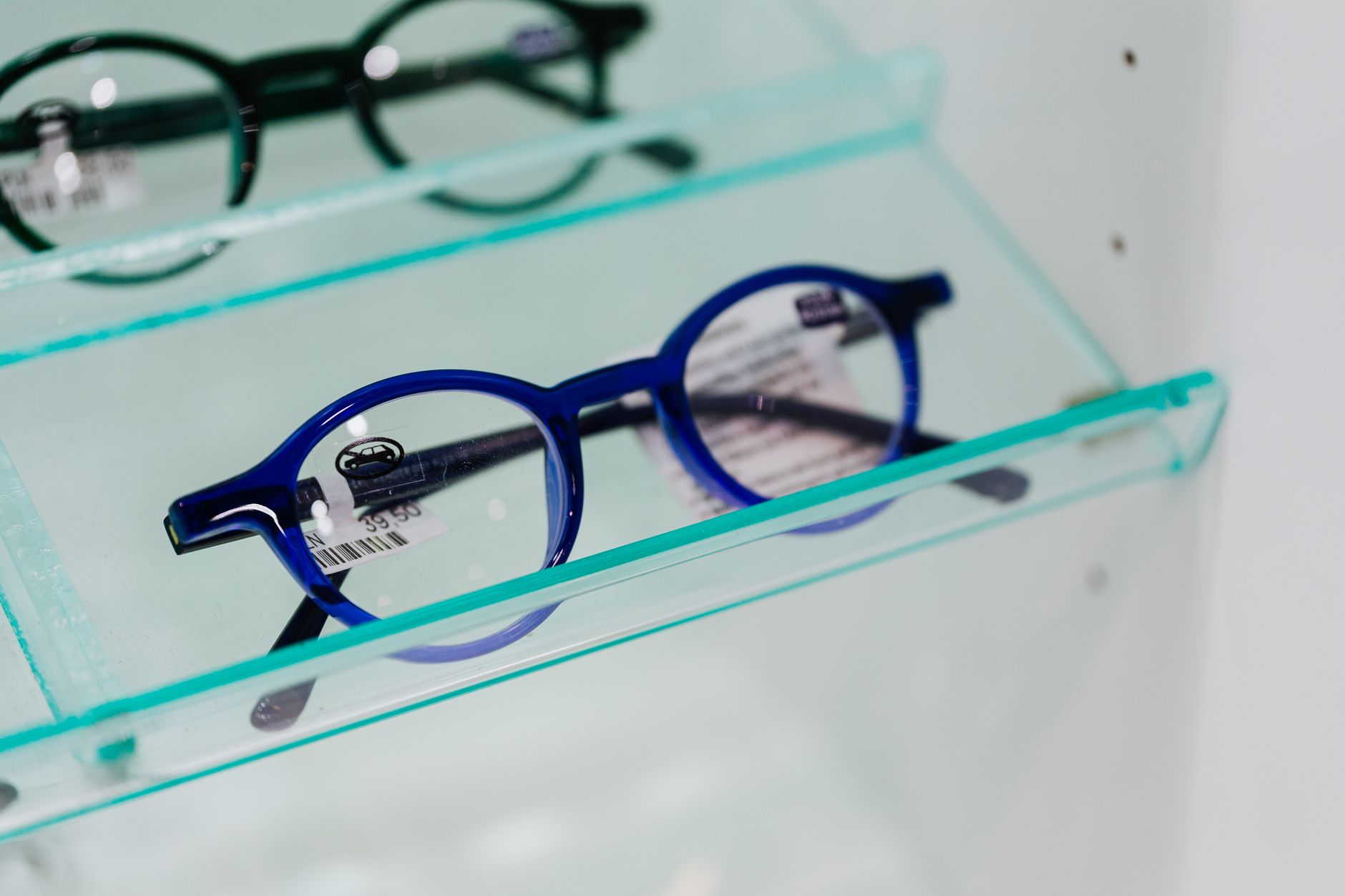
Two frames listed with similar measurements can sit completely differently on the same face, because fit is about proportion and geometry, not just width in millimetres. Check where the frame sits relative to your eyebrows, how much it grips at the temples, and whether the bridge rests without pinching or sliding.
A frame that’s technically the right width for your face can still look wrong if the proportions are off — this is covered properly at how wide should a frame be relative to your face? Nose pads and bridge style also change the comparison considerably: a saddle bridge distributes weight differently to a pair with adjustable pads, and if your bridge is narrow, adjustable pads (detailed at what are nose pads for, and when do you need adjustable ones?) can be the deciding factor between two otherwise similar frames.
Face-shape guidance — round faces suit more angular frames, and so on — is a useful starting point, not a rule. Plenty of people look better ignoring it entirely, and the conventions themselves are worth questioning rather than following blindly; the face shape & fit archive goes into where these ideas hold up and where they don’t.
How do you compare the lenses and coatings included?
This is often where two frames at the same price differ the most, because the frame itself might be nearly identical while the lens package is not. Ask specifically what’s included: the coating, the lens material, and whether anything has been upgraded as standard.
An anti-reflective coating is not cosmetic — it changes glare and how the lens performs at night, and it’s worth understanding what it’s actually doing before comparing whether one pair has it and another doesn’t, covered at what is an anti-reflective coating actually doing? The same goes for scratch-resistant coatings, which resist wear rather than prevent it entirely.
If blue-light filtering is offered as an upgrade on one pair and not the other, treat it as a minor tiebreaker at most. The marketing around blue light and screen strain has moved well ahead of the evidence for it — worth reading before paying extra for it either way, at the lenses & coatings archive.
None of this is a substitute for a proper prescription conversation. Anything about lens power, index, or whether a particular lens type suits your prescription is a question for your optician, not a styling comparison.
Does it matter if one pair is a licensed brand?
Not in the way most people assume. A licensed brand means a fashion house’s name is on a frame manufactured under agreement by a separate eyewear company — it says nothing on its own about the quality of that particular pair. Two frames from the same licensing group, at the same price, can still differ in every way already covered here.
It’s worth understanding how that system works before it factors into a decision at all, at what is a licensed brand, and who makes the frames? and, more broadly, what you’re actually paying for once a designer name is attached, at what are you really paying for in a designer frame?
What if one pair is sunglasses?
If either frame is a pair of sunglasses, the comparison needs one extra, non-negotiable check: the UV rating. A darker lens is not a better lens — a tint without a stated UV filter can be worse than wearing no sunglasses at all, because the darkness causes the pupil to open wider, letting in more unfiltered UV light. Look for UV400 or a stated 100% UVA/UVB protection, not for how dark the lens looks or what the frame costs. This holds regardless of price, and it’s explained fully at what does UV400 rating mean?
Beyond that, compare lens colour and category the same way you’d compare a coating — a gradient lens and a solid tint change what you see differently, and polarisation is a separate feature from UV protection entirely, not an upgrade to it. The sunglasses archive covers these distinctions individually.
What’s the simplest way to decide between two frames?
Handle both, wear both in front of a mirror for longer than feels necessary, and ask what’s included rather than what’s promised. Compare material honestly, check the hinge action, confirm the fit sits right without adjustment, and get a straight answer on the lens package before price becomes the deciding factor at all.
If the two frames still feel genuinely equal once all of that is accounted for, the decision comes down to which one you actually want to wear — which, for something on your face every day, is not a small consideration. The buying & value archive has more on making that call without overthinking it.
The Designer Glasses publishes general information and style opinion, not professional advice. We are writers and enthusiasts, not opticians, optometrists or dispensing opticians. Nothing here interprets a prescription, recommends a lens power, or tells you whether you need correction — only an eye examination can do that. If your vision changes suddenly, or you have eye pain, flashes, new floaters or halos around lights, treat it as urgent and contact an eye care professional the same day. Sunglasses should carry a stated UV rating: a dark lens without UV filtering is worse than none at all.